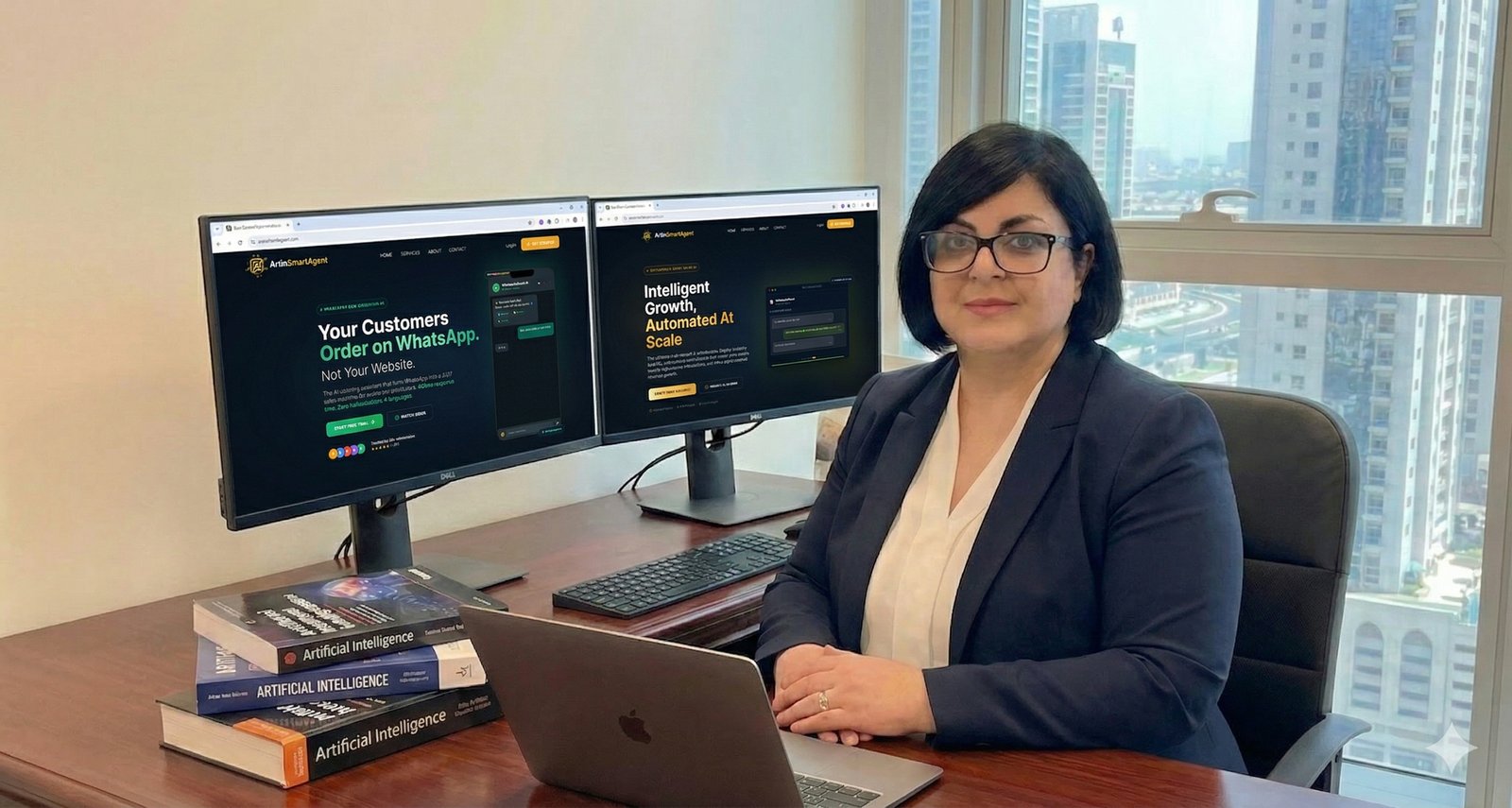
The Dubai skyline, ever-reaching, mirrors the ambitions of its businesses. For nearly two decades, I’ve watched, adapted, and innovated within this dynamic landscape, from the early days of basic web automation to the sophisticated AI solutions that are now reshaping every facet of commerce. Today, as we stand on the cusp of 2026, the question isn’t *if* AI will transform your business, but *how* you’ll harness its power without getting lost in complexity or burdened by exorbitant costs. This comprehensive **AI automation tutorial** will guide you through leveraging white-label solutions for everything from **WhatsApp business bot setup** to advanced **business process automation**. This is where white-label AI emerges as the unsung hero for Dubai’s SMBs – a strategic lever for growth that allows you to deploy cutting-edge intelligence under your own brand, often in a fraction of the time and at a fraction of the cost of building from scratch. Join me as I share ArtinWebs’ journey, demystify white-label AI, and provide a roadmap for leveraging it to thrive in the UAE’s competitive market, focusing on practical **AI automation tutorial** steps.
The Dawn of AI in Dubai: A Founder’s Journey and the White-Label Advantage
From Early Automation to AI Revolution: An 18-Year Perspective
My journey in the UAE’s digital landscape began almost two decades ago, long before “AI” was a household term. Back then, “automation” meant setting up a robust CRM system, perhaps some basic email marketing sequences, or custom scripts to pull data. At ArtinWebs, our focus was on building solid digital foundations for businesses in Dubai – enhancing their online presence, streamlining basic processes, and ensuring they could compete in a rapidly globalizing market. We were laying the groundwork for what would become sophisticated **business process automation**. We saw firsthand the power of even rudimentary automation to free up valuable time and resources for our clients, whether they were a burgeoning trading company in Jebel Ali or a boutique luxury retailer in Downtown.
The Dubai B2B market, in particular, has always been characterized by its agility and ambition. Businesses here are quick to adopt, eager to innovate, and constantly seeking an edge. As the internet evolved, so did the demands. Clients wanted more than just a website; they wanted systems that *worked for them*, intelligently. The shift towards true AI began subtly, with the emergence of natural language processing for chatbots, then machine learning for data analysis, and now, generative AI that can create content, summarize information, and even make decisions. This evolution brought with it a new set of challenges for Small and Medium-sized Businesses (SMBs). The cost of developing custom AI solutions from the ground up was astronomical, requiring specialized talent that was hard to find and even harder to retain. The complexity was daunting, often demanding a full R&D department. Many SMBs felt locked out, unable to access the very technology that was rapidly becoming essential for survival, let alone growth. This chasm between cutting-edge AI capabilities and accessible, affordable implementation for the average Dubai business is precisely where white-label solutions began to shine as a pragmatic, powerful answer for scalable **business process automation**. It became clear that the path forward wasn’t just about building AI, but about making AI accessible and deployable for everyone.
Why White-Label AI is the Game Changer for UAE Businesses
So, what exactly is white-label AI, and why is it so transformative for businesses operating in a market as dynamic as the UAE? Simply put, white-label AI refers to pre-built, fully functional artificial intelligence solutions developed by experts, which can then be rebranded and offered by another company as if it were their own proprietary technology. Think of it as buying a beautifully engineered car chassis, then adding your own custom paint job, interior, and branding before selling it under your dealership’s name. The core engine, the complex mechanics, are already perfected.
For Dubai SMBs, the benefits are profound and immediately impactful. Firstly, there’s the unparalleled cost-effectiveness. Developing AI from scratch can run into millions of dirhams and take years. White-label solutions eliminate the need for heavy R&D investment, specialized AI engineers, and the associated infrastructure costs. You’re leveraging technology that’s already been proven, debugged, and optimized, making it an ideal foundation for any **AI automation tutorial**. Secondly, rapid deployment is a massive advantage. In Dubai’s fast-paced environment, speed to market can be the difference between leading and lagging. A white-label WhatsApp bot, for instance, can be set up and operational in weeks, not months or years. This rapid deployment is key for effective **WhatsApp business bot setup** and overall **AI automation tutorial** applications. Thirdly, it allows you to maintain absolute brand consistency. The AI tools you deploy will carry your logo, your colors, your brand voice, seamlessly integrating into your existing customer experience. Your clients won’t know (or care) that the underlying technology wasn’t built in-house; they’ll only experience the enhanced service and efficiency under your trusted brand. Finally, it democratizes access to expert-built technology. You don’t need an in-house team of data scientists to offer sophisticated AI-powered customer support or advanced analytics.
Consider a real-world scenario from the UAE market: a mid-sized e-commerce business specializing in fashion. Instead of hiring a team to build a recommendation engine, a customer service chatbot, and an inventory forecasting tool, they could adopt white-label versions of each. The recommendation engine integrates seamlessly into their website, powered by a third-party AI but displaying their brand. The customer service chatbot handles inquiries 24/7 under their brand name. The inventory forecasting tool helps them manage stock with far greater accuracy. This approach allows them to compete with larger players, enhance customer experience, and optimize operations without the prohibitive costs and time traditionally associated with AI development, giving them a significant competitive edge in a crowded market through efficient **business process automation**.
Demystifying White-Label AI: What It Is and Why Your Business Needs It Now
White-Label vs. Custom: Understanding the Strategic Choice for SMBs
When an SMB in Dubai considers adopting AI, one of the first strategic crossroads they encounter is the choice between building a custom solution from the ground up or leveraging a white-label platform. It’s a critical decision that hinges on budget, timeline, unique requirements, and long-term vision. Let me break it down from my 18 years of experience watching businesses navigate this.
Building a custom AI solution means developing every single component yourself: from data collection and model training to deployment and maintenance. This path offers unparalleled flexibility and the ability to create something truly bespoke, perfectly tailored to the most niche, complex business requirements. However, it comes with a hefty price tag – often six or seven figures in AED – a lengthy development cycle that can span many months or even years, and the need for a highly specialized in-house team of AI engineers, data scientists, and project managers. For the vast majority of Dubai’s SMBs, this is simply not a viable option. The capital expenditure, the risk of project delays, and the challenge of talent acquisition are too significant.
White-label AI, on the other hand, is the strategic antithesis. You’re acquiring a mature, pre-built AI engine or application that has already undergone rigorous development, testing, and refinement by specialized AI companies. Your investment primarily goes into licensing, customization, and integration. This choice dramatically accelerates your speed to market – you can deploy sophisticated AI capabilities in a matter of weeks or even days. It’s significantly more cost-effective, bypassing the need for extensive R&D and specialized hiring. Furthermore, white-label platforms often come with cutting-edge features that are continuously updated by the provider, ensuring you always have access to the latest advancements without lifting a finger. This allows your business to focus on its core operations, rather than diverting precious resources into becoming an an AI development house.
There’s a common misconception that white-label solutions are “generic” or “less powerful” than custom builds. This couldn’t be further from the truth in today’s market. Modern white-label AI platforms are designed with extensive customization capabilities. You can brand them with your company’s logo and color schemes, integrate them seamlessly with your existing systems (CRMs, ERPs, etc.), and train them on your specific data to ensure they speak your brand’s language and understand your unique customer base. For instance, a white-label AI customer service bot can be trained on your specific product FAQs, pricing structures, and even regional colloquialisms, making it feel entirely bespoke to your customers. The strategic choice for SMBs is clear: unless you have a truly unique, highly specialized AI requirement that no existing platform can address, and the budget to match, white-label AI offers a faster, more affordable, and less risky path to leveraging this transformative technology. It’s the ideal starting point for any practical **AI automation tutorial** for SMBs looking to implement **business process automation**.
Identifying Opportunities: Where White-Label AI Delivers Immediate ROI
The beauty of white-label AI lies in its versatility and its ability to deliver tangible, measurable return on investment (ROI) across various departments within a typical Dubai SMB. From my vantage point, having helped countless businesses integrate these solutions, the opportunities are abundant. Let’s look at some practical examples of how white-label AI can drive **business process automation**:
* **Customer Service:** This is often the lowest-hanging fruit. A white-label AI chatbot or virtual assistant can handle a vast percentage of routine inquiries 24/7, reducing the load on human agents, improving response times, and enhancing customer satisfaction. This is a prime example of effective **business process automation**.
Imagine a Dubai-based real estate agency. Their white-label WhatsApp bot can qualify leads by asking about budget, preferred location (e.g., Downtown, Springs, JLT), property type, and move-in date, then automatically schedule viewings or pass hot leads to human agents. This significantly reduces the time agents spend on initial filtering, allowing them to focus on closing deals. This is a practical **WhatsApp business bot setup** scenario that delivers immediate ROI, a key takeaway from any **AI automation tutorial**.
* **Sales & Marketing:** White-label AI can power personalized product recommendations on e-commerce sites, automate lead scoring, and even generate personalized email content. For a luxury car dealership in Sheikh Zayed Road, a white-label AI could analyze website visitor behavior, identify patterns of interest in specific models, and trigger personalized follow-up emails highlighting relevant features or booking a test drive.
* **Internal Operations:** Back-office tasks are ripe for automation. Think HR, finance, and logistics. A white-label AI-powered document processing tool can extract data from invoices, purchase orders, or employee records, reducing manual data entry errors and speeding up processes. For a logistics company operating across the UAE, a white-label AI could handle routine shipment tracking inquiries via a bot, while internally, it could process customs declarations or optimize delivery routes based on real-time traffic data, leading to significant fuel and time savings through advanced **business process automation**.
Let’s quantify this. For a mid-sized trading company in Al Quoz, implementing a white-label AI customer service bot reduced their inbound call volume by 40% within three months. This allowed them to reallocate two full-time customer service agents to more complex, high-value tasks, saving them approximately AED 15,000 per month in operational costs, while simultaneously improving customer satisfaction scores by 15%. This isn’t just theory; these are the kinds of immediate, measurable impacts we see on the ground here in Dubai. The ROI isn’t just about cost savings; it’s about improved efficiency, enhanced customer experience, and allowing your human capital to focus on strategic initiatives rather than repetitive tasks.
Elevating Customer Engagement: White-Label Solutions for Seamless Interactions
Mastering WhatsApp Business Bot Setup for the Middle East Market
In the Middle East, particularly the UAE, WhatsApp isn’t just an app; it’s the primary mode of communication for personal and business interactions. Ignoring its dominance is akin to ignoring email in the early 2000s. For any Dubai business looking to elevate customer engagement, mastering **WhatsApp Business Bot Setup** is no longer optional – it’s essential. This is precisely where white-label AI provides an incredibly powerful, accessible solution, and this section serves as an **AI automation tutorial** for it.
Imagine you’re a local restaurant chain in Dubai, and customers frequently ask about daily specials, opening hours, or delivery options. A white-label WhatsApp business bot can handle all these queries instantly, 24/7. Here’s a conceptual **AI automation tutorial** for how you might approach setting up such a bot using a white-label platform:
1. **Platform Selection:** Choose a robust white-label WhatsApp Business API provider that offers bot development capabilities. Many platforms provide intuitive drag-and-drop interfaces.
2. **Account Verification:** Connect your official WhatsApp Business API account. This typically involves Facebook Business Manager verification.
3. **Define Intents & Entities:** This is the core of your bot’s intelligence.
* **Intents:** What actions or questions do users have? (e.g., `OrderFood`, `CheckHours`, `GetLocation`, `ViewMenu`).
* **Entities:** What specific information do you need to extract? (e.g., `DishName`, `Time`, `Location`, `DeliveryAddress`).
4. **Craft Conversational Flows:** Design the dialogue. For example:
* User: “Hi, what are your specials today?”
* Bot: “Hello! Our specials today include [Dish 1] and [Dish 2]. Would you like to see the full menu or place an order?”
* User: “Order [Dish 1]”
* Bot: “Great choice! What’s your delivery address?”
5. **Multilingual Support:** This is crucial for the UAE. Ensure your white-label platform supports both Arabic and English. You’ll need to train your bot on both languages for seamless switching. Our white-label solutions often come with this capability built-in, meaning your bot can greet a customer in Arabic based on their device language and continue the conversation fluently.
6. **Integration with CRM/POS:** Connect your bot to your existing Customer Relationship Management (CRM) or Point of Sale (POS) system. This allows the bot to capture lead information, create orders, or update customer records automatically. For instance, if a customer asks to book a table, the bot can check availability in your reservation system and confirm.
7. **Testing & Refinement:** Thoroughly test your bot with various scenarios and languages. Gather feedback and continuously refine its responses and flows.
The key features of a well-implemented white-label WhatsApp bot in Dubai include automated FAQs, efficient lead capture for sales teams, appointment booking for service providers, and seamless integration with existing business systems. This comprehensive **WhatsApp business bot setup** guide highlights the core steps for effective **business process automation**. The trick is to craft engaging bot dialogues that maintain a human touch. Even though it’s AI, the language should be friendly, helpful, and reflect your brand’s personality. We’ve seen businesses dramatically improve customer satisfaction and reduce operational costs by deploying such bots. To explore how we tailor these solutions for your specific needs, you can learn more about our AI automation services.
Crafting Intelligent AI Agent Development Guide for 24/7 Support
Moving beyond basic, rule-based chatbots, the next frontier in customer engagement is the intelligent white-label AI agent. These are not merely programmed to answer FAQs; they are designed to understand complex intent, maintain context across conversations, and even perform multi-step problem-solving. Imagine an AI agent that can not only tell a customer their flight status but also rebook it, process a refund, or upsell them on a lounge pass, all while understanding the nuances of their request. This is where a strategic **AI agent development guide** becomes invaluable, even with white-label solutions.
The core idea behind these advanced white-label AI agents is to emulate human-like interaction as much as possible, offering truly 24/7 support without human intervention for a significant percentage of inquiries. Here’s a conceptual approach to developing such an agent using white-label platforms. This serves as a practical **AI agent development guide** for advanced applications, a crucial step in your overall **AI automation tutorial** journey.
1. **Define Core Objectives:** What complex tasks should the AI agent handle? (e.g., full order management, technical support troubleshooting, personalized financial advice, HR queries).
2. **Intent Recognition & Entity Extraction (Advanced):** While similar to basic bots, AI agents require a much deeper understanding.
* **Intents:** More granular and overlapping (e.g., `ChangeBooking` vs. `CancelBooking` vs. `ModifyPassengerDetails`).
* **Entities:** Extracting specific data points within complex sentences (e.g., “I want to change my flight from Dubai to London on the 15th of March to the 20th of April for two adults and one child”).
3. **Conversational Flow Design (Contextual):** This is where white-label platforms truly simplify complexity. You define branching logical paths that account for user preferences, historical data, and previous turns in the conversation. The agent remembers past interactions, so it doesn’t ask for the same information repeatedly.
4. **Integration with Backend Systems:** An intelligent AI agent is only as good as its access to data. White-label solutions excel at offering pre-built connectors or easy API integrations with:
* CRMs (Salesforce, HubSpot)
* ERPs (SAP, Oracle)
* Databases
* Payment Gateways
* Knowledge Bases
5. **Knowledge Base Integration:** Feed your agent with extensive knowledge bases, product manuals, policy documents, and FAQs. The AI agent uses natural language understanding to retrieve relevant information and synthesize responses.
6. **Learning & Improvement:** White-label AI agents often come with built-in machine learning capabilities. They learn from interactions, identifying common queries they struggle with, which allows for continuous improvement through retraining and human oversight.
**Use cases for intelligent white-label AI agents are expansive:**
* **24/7 Customer Support:** Handling complex product returns, warranty claims, or subscription modifications.
* **Personalized Product Recommendations:** Going beyond basic recommendations to suggest items based on a customer’s browsing history, purchase patterns, and even explicit preferences expressed during a conversation.
* **Proactive Outreach:** Identifying customers who might be at risk of churn or due for an upgrade and initiating a personalized conversation.
* **Handling Payment Inquiries:** Securely guiding customers through payment processes, updating billing information, or explaining invoice details.
White-label platforms drastically simplify the development and deployment of these sophisticated AI agents. Instead of building complex machine learning models and natural language processing pipelines from scratch, businesses can configure, train, and launch an intelligent agent within weeks, leveraging the expertise and infrastructure of the white-label provider. This empowers even smaller businesses in Dubai to offer the kind of advanced, always-on support previously only available to multinational corporations, following a clear **AI agent development guide**.
Powering Internal Efficiency: White-Label Solutions for Business Process Automation
Unleashing n8n Workflow Automation: A Practical Approach to Operations
While customer-facing AI agents garner a lot of attention, the real goldmine for many Dubai SMBs lies in transforming internal operations through **business process automation**. This is where low-code/no-code platforms like n8n become indispensable, acting as the connective tissue that integrates various white-label AI tools into seamless, automated workflows. From my experience, n8n is a particularly powerful open-source choice that offers immense flexibility, allowing businesses to stitch together different applications and AI functionalities without writing extensive code. This section provides a practical **n8n workflow automation** tutorial, an essential part of your broader **AI automation tutorial**.
Let’s consider a practical, conceptual example: automating lead nurturing from a web form submission, integrating it with a CRM, and generating personalized email follow-ups using a white-label AI for content generation. This is a common pain point for many sales and marketing teams in Dubai, and a perfect use case for **n8n workflow automation**.
**Conceptual n8n Workflow Automation Steps:**
1. **Trigger:** A new lead submits a contact form on your website (e.g., powered by HubSpot, WordPress, or a custom form).
2. **Web Hook/Form Submission:** n8n’s workflow starts with a “Webhook” node or a direct integration with your form builder, capturing all submitted data (name, email, company, inquiry).
3. **CRM Integration:**
* **Node:** Add a “CRM” node (e.g., Salesforce, Zoho CRM, Pipedrive).
* **Action:** “Create New Contact/Lead.” Map the data from the web form submission directly into the relevant CRM fields.
* **Conditional Logic (Optional):** If the lead already exists, update their record instead of creating a new one.
4. **White-Label AI for Lead Qualification/Enrichment:**
* **Node:** Integrate a “HTTP Request” node or a specific “AI” node if your white-label AI platform has one.
* **Action:** Send the lead’s company name and inquiry text to a white-label AI service (e.g., a custom-trained model for industry classification or sentiment analysis).
* **Result:** The AI classifies the lead’s industry, assesses their potential interest level, or even suggests next best actions.
5. **White-Label AI for Personalized Email Content Generation:**
* **Node:** Another “HTTP Request” or “AI” node, connecting to a white-label generative AI platform (e.g., a fine-tuned GPT model).
* **Action:** Input the lead’s name, company, inquiry details, and the AI’s qualification output.
* **Prompt Example (to AI):** “Draft a personalized follow-up email for [Lead Name] from [Company Name] who inquired about [Inquiry Type]. The lead is [AI Qualification – e.g., ‘high potential, interested in SaaS solutions’]. Emphasize our value proposition for their industry. Include a call to action to schedule a demo.”
* **Result:** The AI generates a unique, context-aware email draft.
6. **Email Sending:**
* **Node:** Add an “Email” node (e.g., Gmail, SendGrid, Outlook).
* **Action:** Send the AI-generated email to the lead.
* **Dynamic Content:** Populate the email subject and body with the AI’s output and lead details.
7. **Internal Notification (Optional):**
* **Node:** “Slack” or “Teams” node.
* **Action:** Notify the sales team about the new lead and the AI’s insights.
**Benefits of n8n workflow automation:**
* **Reduced Manual Effort:** No more manual data entry into the CRM or crafting individual follow-up emails. This saves hours for sales and marketing teams, allowing them to focus on high-impact activities.
* **Improved Data Accuracy:** Automated data transfer minimizes human error.
* **Faster Response Times:** Leads receive personalized follow-ups almost instantly, significantly improving conversion rates.
* **Scalability:** As your business grows, the workflow scales effortlessly without requiring additional headcount for these repetitive tasks.
This is a prime example of effective **business process automation** using **n8n workflow automation**. At ArtinWebs, we’ve implemented similar **business process automation** for clients, integrating solutions like our WholesaleOS platform with n8n to streamline complex B2B ordering and inventory management, demonstrating how white-label components can synergize for powerful results through **n8n workflow automation**.
Transforming Back-Office Tasks: From HR to Supply Chain with AI
The impact of white-label AI extends far beyond customer-facing interactions and marketing. The back office, often seen as a cost center, is ripe for transformation, offering substantial savings and efficiency gains for Dubai businesses. This is where strategic **business process automation** truly shines.
Let’s explore key areas:
Curious how much an AI Agent could save your UAE business?
Calculate your exact Visa, Gratuity, and workspace savings compared to hiring a human.
Launch AI ROI Calculator* **Human Resources (HR):**
* **Automated Onboarding:** White-label AI can automate the collection and processing of new employee documents (visas, Emirates ID, contracts). An AI-powered form parser can extract data, populate HR systems, and trigger subsequent onboarding steps.
* **Resume Screening:** AI can analyze vast numbers of resumes, identifying candidates whose skills and experience best match job requirements, saving recruiters hundreds of hours.
* **Employee Support:** A white-label internal AI agent can answer common HR questions (e.g., leave policies, benefits, payroll inquiries) 24/7, reducing HR department workload.
* **Finance & Accounting:**
* **Invoice Processing:** This is a classic example. White-label OCR (Optical Character Recognition) technology, often bundled with AI capabilities, can extract data from scanned invoices – vendor names, amounts, dates, line items – and automatically input them into accounting software (e.g., QuickBooks, SAP). This eliminates manual data entry, reduces errors, and speeds up payment cycles.
* **Expense Management:** Employees can simply snap a picture of a receipt, and white-label AI-powered OCR processes it, categorizes the expense, and initiates the approval workflow.
* **Fraud Detection:** AI can analyze transaction patterns to flag suspicious activities, enhancing financial security.
* **Supply Chain & Logistics:**
* **Inventory Forecasting:** White-label AI models can analyze historical sales data, seasonal trends, and even external factors (like public holidays or economic forecasts) to predict demand with much greater accuracy, optimizing inventory levels and reducing waste.
* **Vendor Communication:** AI-powered agents can handle routine inquiries to and from suppliers regarding order status, delivery schedules, and discrepancies, freeing up supply chain managers.
* **Route Optimization:** While complex, white-label AI components can integrate with logistics software to suggest optimal delivery routes, considering traffic, delivery windows, and vehicle capacity.
The underlying technology often involves leveraging white-label OCR for document automation and RPA (Robotic Process Automation) components. RPA bots, powered by AI, can mimic human actions on a computer, interacting with various applications to complete repetitive tasks. For example, an RPA bot could log into a supplier portal, download a report, use white-label OCR to extract key data, and then upload that data to your internal ERP system – all without human intervention.
The strategic value here is immense. By automating these back-office tasks, Dubai businesses can significantly reduce operational costs, minimize human error, and accelerate processes that were once bottlenecks. This comprehensive approach to **business process automation** is key to unlocking new levels of efficiency, as highlighted in this **AI automation tutorial**. More importantly, it frees up skilled human capital – your HR managers, finance controllers, and supply chain specialists – to focus on strategic planning, problem-solving, and innovation, tasks that truly require human intellect and creativity, driving greater value for the company. This transformation isn’t just about cutting costs; it’s about unlocking human potential and redirecting it towards growth.
Strategic Implementation: Your AI Automation Tutorial for White-Label Success
The ArtinWebs Framework: Selecting and Customizing Your White-Label AI Stack
Implementing white-label AI isn’t just about buying a product; it’s about strategically integrating a solution that genuinely solves your business problems and aligns with your growth objectives. Over my 18 years, I’ve seen successful implementations and those that faltered, and the difference often lies in a structured approach. Here’s a comprehensive **AI automation tutorial**, drawing from the ArtinWebs framework, for selecting and customizing your white-label AI stack in Dubai, covering everything from initial assessment to **WhatsApp business bot setup** and **n8n workflow automation**.
1. **Assess Your Specific Business Needs and Pain Points:**
* Before looking at any technology, identify your most pressing challenges. Where are you losing time, money, or customer satisfaction? Is it lead qualification, customer support, data entry, or inventory management?
* **Example:** A Dubai-based construction company might identify that their project managers spend 20% of their time manually updating project progress reports from various sources. Their pain point: inefficiency and potential data discrepancies.
* **Ask:** What specific outcomes do you want to achieve? (e.g., “Reduce customer support response time by 50%,” “Automate 70% of lead qualification,” “Decrease manual data entry errors by 80%”).
2. **Define Key Criteria for Vendor/Platform Selection:**
* **Scalability:** Can the solution grow with your business? If you start with 100 customer inquiries a day, can it handle 10,000 without breaking the bank or requiring a complete overhaul?
* **Integration Capabilities:** How easily does it integrate with your existing CRM, ERP, accounting software, or communication channels (e.g., WhatsApp, website)? Look for platforms with extensive APIs or pre-built connectors.
* **Security & Compliance:** This is paramount, especially in the UAE. Does the vendor meet local data privacy regulations? How do they handle data encryption and access control?
* **Support & Documentation:** What kind of technical support is available? Is there comprehensive documentation and community support?
* **Local Relevance:** Does the platform understand regional nuances, like multilingual support (Arabic/English) or specific payment gateway integrations common in the UAE?
* **Customization Potential:** Beyond branding, how much can you fine-tune the AI’s behavior, rules, and responses?
3. **Strategies for Effective Customization:**
* **Brand Voice & Personality:** Even if the AI is white-label, its communication style must reflect your brand. Work with the vendor to customize dialogues, tone, and specific phrasing.
* **Data Training:** The most powerful customization comes from training the AI on your specific business data – your FAQs, product catalogs, customer interaction history, and internal knowledge bases. This makes the AI truly “yours.”
* **Workflow Mapping:** Map out the exact steps you want the AI to automate or assist with. This ensures the white-label solution fits seamlessly into your operational requirements, rather than forcing your operations to fit the AI.
* **Iteration & Feedback:** Start small, gather feedback from initial users (both employees and customers), and continuously refine the AI’s performance and customization.
4. **Phased Implementation Approach & Setting Clear Objectives:**
* Don’t try to automate everything at once. Start with a pilot project – a specific, well-defined problem with clear, measurable outcomes.
* **Example:** For the construction company, a pilot could be automating the collection of daily site progress updates via a WhatsApp bot from foremen, feeding data into a white-label project management dashboard.
* Set realistic, measurable objectives (KPIs) for your pilot. This allows you to demonstrate early success, build internal buy-in, and justify further investment.
By following this structured approach, Dubai SMBs can move beyond generic solutions and build an AI stack that is truly an extension of their brand and a driver of their unique business goals.
Launching and Scaling: Best Practices from Dubai’s AI Frontier
Launching a white-label AI solution is just the beginning; the real test, and the real value, comes from successfully scaling it across your organization. Drawing from ArtinWebs’ experience in Dubai, here are best practices for a smooth launch and sustainable growth.
1. **Tips for a Successful Pilot Program:**
* **Choose the Right Initial Project:** Select a project that is impactful enough to demonstrate value but not so complex that it creates unnecessary risk. Ideal pilots address a clear pain point, have easily measurable KPIs, and involve a contained group of users. For instance, automating inbound customer queries for a specific product line or a particular geographical region in Dubai.
* **Measure KPIs Diligently:** Before launch, define what success looks like. Is it reducing response time by 30%? Increasing lead conversion by 10%? Track these metrics rigorously from day one.
* **Gather Diverse Feedback:** Collect feedback from both end-users (customers) and internal stakeholders (employees interacting with the AI). Use surveys, direct interviews, and analytics to understand what’s working and what needs refinement. Don’t be afraid to iterate quickly based on this feedback.
2. **Training Your Team: Empowering Employees, Fostering Innovation:**
* **Communicate the “Why”:** Employees often fear AI will replace their jobs. Clearly communicate that AI is a tool to *augment* their capabilities, freeing them from repetitive tasks to focus on more strategic, creative, and human-centric work.
* **Comprehensive Training:** Provide hands-on training for employees who will interact with or manage the AI. This includes how to use the new tools, how to escalate complex issues to human agents, and how to interpret AI-generated insights.
* **Identify AI Champions:** Designate internal “champions” or power users who can evangelize the benefits of AI, assist colleagues, and provide valuable feedback to the implementation team. This fosters a culture of innovation and adoption from within.
3. **Strategies for Scaling White-Label AI Solutions:**
* **Start Small, Think Big:** Once your pilot is successful, leverage those learnings. Identify other departments or business units with similar pain points that could benefit from the same (or slightly adapted) white-label AI solution.
* **Modular Expansion:** White-label AI is inherently modular. You might start with a customer service bot, then add an internal HR bot, then integrate an AI-powered lead qualification tool for sales. Build out your AI ecosystem piece by piece.
* **Integration First:** As you scale, always prioritize seamless integration with existing systems. A fragmented AI strategy will lead to inefficiencies, not solve them.
* **Continuous Monitoring and Iteration:** The AI landscape is constantly evolving. Regularly review your AI solutions’ performance, explore new features from your white-label providers, and adapt your strategies. AI is not a one-time deployment; it’s a journey of continuous improvement. This iterative approach is crucial for maximizing long-term value, ensuring your AI solutions remain cutting-edge and relevant in Dubai’s dynamic market. This continuous refinement is a vital part of any successful **AI automation tutorial**. For businesses looking to streamline their sales processes, exploring solutions like B2B Smart Ordering can provide further insights into scaling efficiency with AI.
The Future is Now: What to Expect from White-Label AI in 2026 and Beyond
Emerging Trends: Hyper-personalization, Ethical AI, and Predictive Analytics
As we look towards 2026 and beyond, the evolution of white-label AI promises to be nothing short of revolutionary. My 18 years in the digital space have taught me that technology never stands still, and AI is accelerating at an unprecedented pace. For Dubai businesses, understanding these emerging trends is crucial for staying ahead.
One of the most significant shifts will be towards **hyper-personalization**. White-label AI platforms will leverage increasingly sophisticated data analysis to offer truly individualized experiences, not just based on past purchases, but on real-time behavior, emotional state (inferred through tone analysis), and contextual factors. Imagine a white-label AI agent for a travel agency that proactively suggests a weekend getaway to Salalah based on your recent browsing history, current mood (from social media interactions, if permitted), and the upcoming public holidays in the UAE – complete with personalized itinerary options and dynamic pricing. This level of foresight and tailoring will become a standard expectation.
Another critical area is the growing importance of **Ethical AI and Data Privacy**. As AI becomes more pervasive, concerns around bias, transparency, and data security will escalate. White-label providers are already investing heavily in building AI systems that are fair, accountable, and transparent. For businesses in the UAE, adherence to data protection laws and ethical guidelines will not just be a regulatory requirement but a brand differentiator. White-label solutions will offer built-in compliance features, auditing capabilities, and explainable AI models, giving businesses confidence that their AI is operating responsibly and safeguarding customer data.
Finally, the power of **predictive analytics** will become more accessible than ever through white-label AI. Instead of merely reacting to events, businesses will be able to anticipate them. For example, a white-label AI could predict which customers are likely to churn, which products will be in highest demand next quarter, or which equipment in a factory is likely to fail. This proactive problem-solving capability will move businesses from being reactive to predictive, enabling them to make more informed decisions, optimize resource allocation, and seize opportunities before their competitors even see them. White-label platforms will continue to democratize access to these advanced functionalities, meaning that even a small startup in Dubai will be able to harness the power of predictive models that once required vast data science teams and supercomputers. The future of white-label AI is about making cutting-edge intelligence an everyday reality for every business, regardless of size.
Your Next Steps: Partnering for AI-Powered Growth in the UAE
The narrative of AI in Dubai isn’t one of distant future possibilities; it’s a story unfolding right now, in every sector, every day. As we’ve explored, white-label AI offers a pragmatic, powerful pathway for Small and Medium-sized Businesses to harness this transformative technology without the traditional barriers of cost, complexity, and talent acquisition. From revolutionizing customer engagement with intelligent WhatsApp bots and AI agents to supercharging internal efficiency through **n8n workflow automation** and back-office AI, the immense potential for growth and competitive advantage is undeniable.
This **AI automation tutorial** has shown how white-label solutions simplify **WhatsApp business bot setup**, provide an effective **AI agent development guide**, and enable robust **n8n workflow automation** for comprehensive **business process automation**.
My 18 years in this vibrant market have shown me that success often hinges on embracing innovation strategically. White-label AI isn’t just a trend; it’s a fundamental shift in how businesses can acquire and deploy advanced technological capabilities. It empowers you to maintain your unique brand identity while leveraging the expertise of specialized AI developers, accelerating your journey towards a smarter, more efficient, and more customer-centric operation.
The question isn’t whether your business needs AI, but how effectively and efficiently you will integrate it. Don’t let the perceived complexities deter you. The future of business in the UAE is intrinsically linked with intelligent automation, and white-label AI is your accessible key to unlocking that future. It’s time to move beyond discussion and into action.
We invite you to explore the myriad possibilities that white-label AI can unlock for your business. Discover ArtinWebs’ comprehensive AI automation services and see how we can tailor these solutions to your unique challenges and growth ambitions. Let ArtinWebs be your trusted partner in navigating this exciting landscape, helping you implement white-label AI solutions that drive real, measurable growth through effective **AI automation tutorial** guidance and practical **AI agent development guide** strategies.
Frequently Asked Questions (FAQ)
What is white-label AI and how does it benefit my SMB in Dubai?
White-label AI refers to pre-built artificial intelligence solutions that can be rebranded and integrated into your business operations as if they were developed in-house. For Dubai SMBs, this means faster deployment, lower development costs, access to advanced technology, and the ability to maintain your brand identity while leveraging powerful AI capabilities for customer service, marketing, and operations.
Can white-label AI solutions be customized to fit my brand and specific needs?
Absolutely. While white-label AI solutions come with core functionalities, they are designed for extensive customization. You can tailor their appearance, integrate them with your existing systems, define specific workflows, and train them on your unique data to ensure they perfectly align with your brand voice and operational requirements, especially for tasks like WhatsApp business bot setup or AI agent development.
How quickly can a white-label AI solution like a WhatsApp bot be deployed?
One of the primary advantages of white-label AI is speed. A basic white-label WhatsApp business bot setup can often be deployed within weeks, sometimes even days, depending on the complexity of integrations and customization required. This is significantly faster than building a custom solution from scratch, allowing your Dubai business to see immediate benefits.
Is white-label AI suitable for complex business process automation?
Yes, white-label AI is highly effective for complex business process automation. By integrating various white-label AI components (like natural language processing, computer vision, or machine learning models) with workflow automation platforms like n8n, you can automate intricate multi-step processes across different departments, from HR onboarding to supply chain management and customer relationship management.
What’s the difference between a white-label AI agent and a custom-built one?
A white-label AI agent is an intelligent assistant built on a proven platform, offering robust features and scalability out-of-the-box, which you then brand and customize. A custom-built AI agent is developed from the ground up, requiring significant investment in time, resources, and expertise. White-label agents are ideal for SMBs seeking rapid deployment and cost efficiency, while custom agents suit highly unique and specialized requirements with larger budgets and longer timelines.
The future of your Dubai business is waiting to be written, and AI is the pen. Don’t just observe the transformation – lead it. Let ArtinWebs be your trusted partner in navigating this exciting landscape, helping you implement white-label AI solutions that drive real, measurable growth.
Ready to unlock the power of AI for your business? Contact us today to schedule a consultation and discover how ArtinWebs can tailor an AI automation strategy specifically for you.