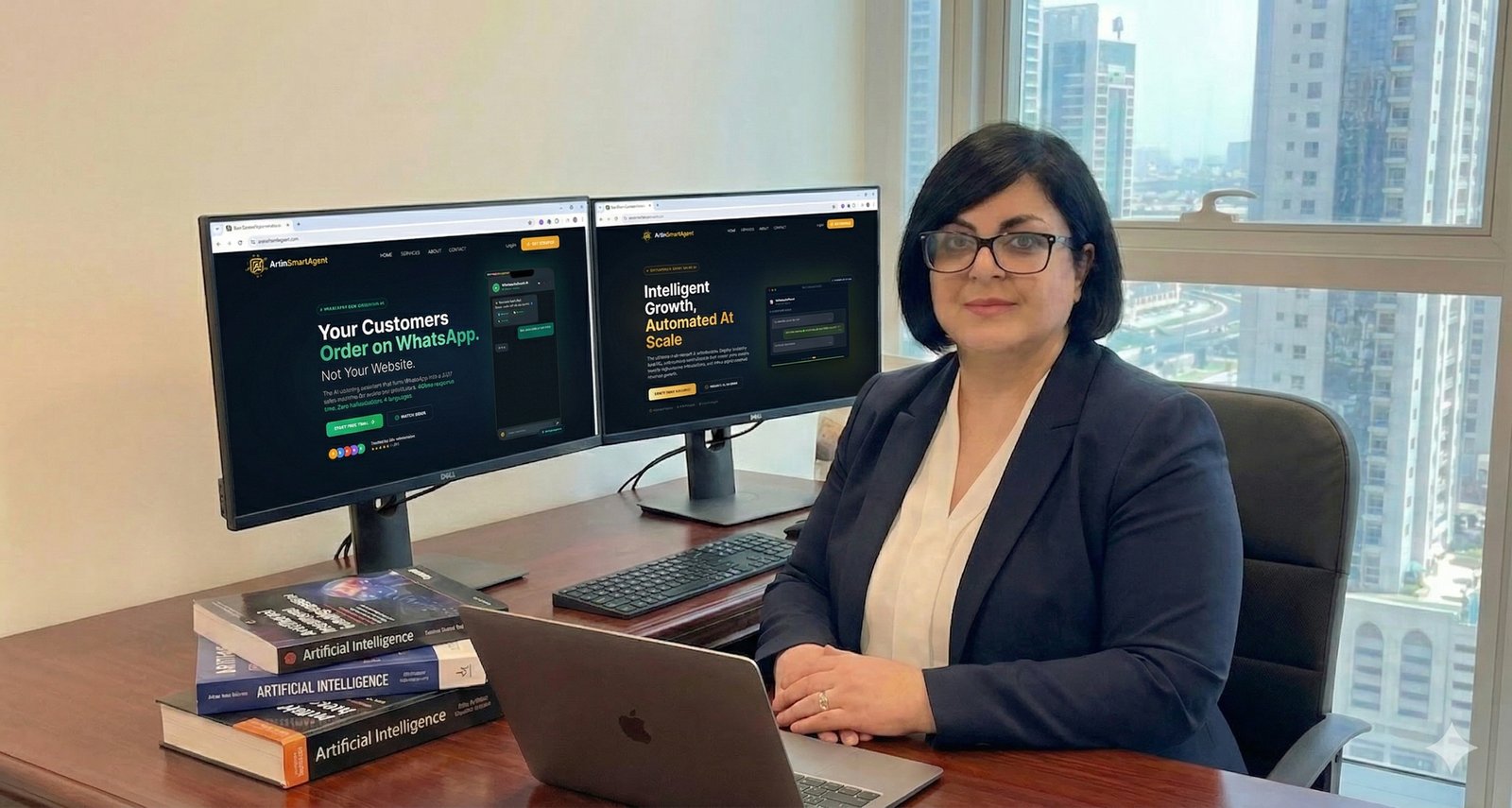
The hum of Dubai is a symphony of ambition, innovation, and relentless progress. For 18 years, ArtinWebs has been right here, in the thick of it, helping businesses not just survive but thrive. And if there’s one constant we’ve observed in this vibrant market, it’s the insatiable appetite for efficiency. We’ve seen businesses blossom from humble beginnings to regional powerhouses, and almost without exception, their growth trajectory was supercharged by strategic adoption of technology. Today, that technology is AI automation, and it’s not a luxury for the tech giants anymore; it’s the very bedrock upon which successful Dubai SMBs are being built.
Picture this: you’re a business owner, juggling customer inquiries, managing inventory, processing orders, and trying to strategize for growth. You’re constantly putting out fires, and the dream of scaling often feels like a distant mirage, drowned out by the daily operational noise. We’ve been there, we’ve guided countless clients through it, and we’ve built the solutions that cut through that noise. This isn’t just a guide; it’s an invitation to rewrite your business narrative. It’s a deep dive into the practical, real-world application of AI automation – specifically WhatsApp bots and n8n workflows – tailored for the unique pulse of the Dubai market. This comprehensive AI automation tutorial will unlock the next chapter of your business, together.
The Dawn of Automation: Our Dubai Journey with AI
From Manual Mayhem to Intelligent Efficiency: An 18-Year Perspective
When ArtinWebs started its journey in Dubai almost two decades ago, the digital landscape was a vastly different beast. The internet was still a burgeoning frontier for many businesses, and the idea of “automation” was often synonymous with basic email autoresponders or rudimentary CRM systems. Our initial focus was on crafting compelling online presences, building robust e-commerce platforms, and making sure businesses in this rapidly expanding city could be found amidst the burgeoning digital noise. We built websites for trading companies in Deira, developed intricate inventory systems for retailers in Bur Dubai, and designed lead generation portals for real estate agencies across Sheikh Zayed Road.
But even with the best websites, we continually encountered the same bottlenecks: the sheer volume of manual tasks that consumed valuable human potential. We saw sales teams drowning in repetitive lead qualification calls, customer service departments struggling to keep up with inquiries, and operations managers manually reconciling data across disparate spreadsheets. A client, a prominent building materials supplier in Al Quoz, once showed us their daily routine: hundreds of WhatsApp messages, dozens of calls, and a physical ledger for orders, all before even touching their accounting software. They were growing, yes, but at the cost of immense stress and an ever-present risk of human error. It was a manual mayhem that hindered true scalability.
This constant struggle for efficiency became our driving force. We began exploring ways to streamline these processes, initially with simpler scripting and integration tools. Then, about five years ago, something shifted dramatically. The advent of accessible Artificial Intelligence, particularly in areas like Natural Language Processing (NLP) and machine learning, presented a paradigm-altering opportunity. We realized AI wasn’t just about futuristic robots; it was about intelligent efficiency – automating not just tasks, but entire cognitive processes. It allowed us to move beyond simply building digital tools to creating intelligent systems that could learn, adapt, and make decisions, freeing up our clients’ teams to focus on strategy, relationships, and genuine innovation. This was the game-changer, the moment we truly embraced AI as the core of our solution offering, understanding its potential to solve real, pressing business problems right here in Dubai.
Why AI Automation Isn’t Just for Tech Giants Anymore (Especially in Dubai)
There’s a pervasive myth that AI automation is exclusively for the likes of multinational corporations with bottomless budgets and dedicated R&D departments. This couldn’t be further from the truth, especially in a dynamic market like Dubai. We’ve seen firsthand how small and medium-sized businesses (SMBs) here are not just adopting AI, but actually leading the charge in specific niches, leveraging its power to punch far above their weight. The competitive landscape in Dubai is fierce, with businesses from every corner of the globe vying for market share. Standing out isn’t just about having a great product or service; it’s about operational agility, customer responsiveness, and cost-effectiveness.
Consider a boutique fashion retailer in City Walk. They might not have the resources of a global brand, but by automating their social media engagement, inventory updates based on sales patterns, and even personalized customer recommendations via a simple bot, they can offer a level of service and efficiency that rivals much larger players. AI automation democratizes access to advanced capabilities, allowing SMBs to reduce operational costs significantly. Imagine cutting down the time spent on routine customer queries by 70%, or reducing data entry errors by 90%. These aren’t hypothetical figures; these are the results we’ve witnessed with our clients. This translates directly into freeing up human potential. Instead of tedious, repetitive tasks, your team can focus on creative problem-solving, building stronger customer relationships, and strategic growth initiatives.
The core promise of AI automation for Dubai SMBs is simple yet profound: scale without proportional increase in headcount. In a city where talent acquisition can be challenging and operational costs are always a consideration, this ability to do more with existing resources is invaluable. It’s about building a leaner, smarter, and more resilient business that can adapt quickly to market shifts and seize opportunities faster. ArtinWebs has been instrumental in helping businesses across various sectors – from logistics and F&B to real estate and professional services – harness this power, proving that AI is not a distant future, but a present-day imperative for competitive advantage.
Demystifying Business Process Automation (BPA) with AI
Understanding the ‘Why’ and ‘What’ of AI-Driven Business Process Automation (BPA)
When we talk about Business Process Automation (BPA), it’s often misunderstood as simply automating a single task, like sending an email after a form submission. While that’s a part of it, AI-driven BPA is far more comprehensive. It’s about leveraging intelligent technologies to automate end-to-end business processes that typically involve multiple steps, decisions, and interactions across various systems. It’s about transforming entire operational flows, not just individual actions. Think of it as teaching your systems to not just “do” but also “think” and “decide” based on learned patterns and data, mimicking human cognition at scale.
Our first step with any client looking into BPA is to identify the real bottlenecks. We don’t just ask, “What do you want to automate?” but “Where are you losing time, money, and valuable human energy?” In Dubai, common culprits include lead qualification, which can consume hours of sales team time on unqualified prospects; customer support, where agents are swamped with repetitive queries; and data entry, particularly in sectors like logistics or trading where vast amounts of information need to be accurately transferred between systems. For instance, a major logistics firm we worked with was struggling with manual manifest processing – a task prone to errors and delays. By identifying this specific bottleneck, we could design an AI solution.
The Return on Investment (ROI) from such interventions is often staggering. For that logistics firm, the AI-powered manifest processing solution reduced data entry errors by 85% and processing time by 60%, directly impacting delivery speed and customer satisfaction. Another client, a property management company, saw their lead response time drop from an average of 3 hours to under 5 minutes thanks to an AI-driven lead qualification system. This not only improved their conversion rates but also significantly reduced the workload on their sales team. These are tangible benefits: reduced error rates, faster response times, optimized resource allocation, and ultimately, a healthier bottom line. For more insights into how intelligent automation can transform your operations, explore our comprehensive AI automation services.
Mapping Your First Automation Journey: A Practical AI Automation Tutorial
Embarking on your first AI automation tutorial journey might seem daunting, but like navigating the labyrinthine souqs of Dubai, a good map makes all the difference. Our approach at ArtinWebs follows a clear, four-stage process: discovery, design, implementation, and monitoring. First, Discovery: this is where we sit down with you, often with process mapping tools, to meticulously document your current workflows. We look for repetition, manual data transfers, decision points, and potential error sources. Think of it as an operational audit, identifying tasks that are rule-based, high-volume, and time-consuming.
Next, Design: based on the discovery, we conceptualize the automated process. This involves sketching out the ideal flow, identifying which AI components (e.g., NLP for text analysis, machine learning for predictions) are needed, and how they will integrate with your existing systems. We’ll consider the tools of the trade:
- Robotic Process Automation (RPA): For automating repetitive, rule-based digital tasks, often mimicking human interaction with software interfaces.
- Intelligent Process Automation (IPA): Combines RPA with AI capabilities like machine learning, NLP, and computer vision to handle unstructured data and make more complex decisions.
- AI Agents: More advanced, autonomous entities capable of understanding goals, planning actions, and learning from experience, which we’ll delve into later.
For your first project, we strongly recommend starting small and scaling up. Don’t try to automate your entire business in one go. Choose a single, well-defined process with clear inputs and outputs, where a successful automation will demonstrate immediate, measurable value. Perhaps it’s automating the initial screening of job applications, or streamlining customer feedback collection. A small win builds confidence, gathers internal champions, and provides invaluable lessons for larger, more complex automations down the line, helping SMBs avoid overwhelm and ensuring sustainable adoption.
Mastering Communication: Your WhatsApp Business Bot Setup Guide
The Imperative of Instant Communication: Why WhatsApp for Dubai Businesses (and Your WhatsApp Business Bot Setup)
In the Middle East and North Africa (MENA) region, WhatsApp isn’t just another messaging app; it’s the digital town square. In Dubai, its dominance is unparalleled, serving as the primary communication channel for everything from family chats to critical business interactions. For any business operating here, ignoring WhatsApp is akin to ignoring the phone in the 90s – a critical communication misstep. We’ve seen countless instances where businesses that prioritize WhatsApp communication gain a significant edge in customer engagement and satisfaction. Customers expect instant responses, and a WhatsApp Business API bot is the most effective way to deliver that.
The benefits of deploying a WhatsApp Business API bot are manifold. Firstly, it offers 24/7 availability. Imagine a customer service agent who never sleeps, never takes a holiday, and can handle hundreds of queries simultaneously. Secondly, it enables personalized interactions at scale. While the bot follows a script, intelligent design allows it to tailor responses based on user input, historical data, or even location. Thirdly, it’s a powerful tool for lead generation and qualification, capturing essential information and nurturing prospects efficiently. Lastly, it dramatically enhances customer support, providing instant answers to FAQs, tracking order statuses, and resolving simple issues without human intervention.
Consider the real-world scenario of a Dubai real estate agency, a client of ours based in Business Bay. Before their bot, an interested lead inquiring about properties via their website form or direct WhatsApp message might wait anywhere from 30 minutes to a few hours for a human agent to respond. In Dubai’s fast-paced property market, that’s often enough time for a competitor to swoop in. After implementing a simple WhatsApp bot for initial lead qualification, their lead response time became instantaneous. The bot would greet the user, ask about their property interest (buy, rent, investment), preferred location, and budget. This basic qualification meant that by the time a human agent took over, they were already armed with crucial information, and the lead was engaged and warm. This transformation led to a 25% increase in qualified leads and a noticeable improvement in overall conversion rates, proving the bot wasn’t just a cost-saver but a revenue driver.
Building Your First Intelligent WhatsApp Bot: A Hands-On AI Automation Tutorial
Building your first intelligent WhatsApp bot might sound like a highly technical endeavor, but with the right approach, it’s entirely achievable for SMBs. The foundation lies in understanding the core components and following a structured process. Here’s a hands-on guide for your WhatsApp business bot setup:
- Prerequisites: WhatsApp Business API Access: To move beyond the basic WhatsApp Business App, you’ll need access to the WhatsApp Business API. This typically involves working with a WhatsApp Business Solution Provider (BSP) like Twilio, MessageBird, or a direct custom integration through an agency like ArtinWebs. These providers manage the complexities of the API, allowing you to focus on the bot’s functionality.
- Platform Selection: You’ll need a platform to build and manage your bot. Options range from low-code/no-code bot builders that integrate with WhatsApp to custom-developed solutions. The choice depends on your specific needs, budget, and desired complexity.
- Designing Conversational Flows: This is the most crucial step. Think like your customer. What questions do they ask? What information do they need? Map out decision trees that guide the conversation.
- Identify Intents: What is the user trying to achieve? (e.g., “Inquire about a product,” “Check order status,” “Book an appointment”).
- Craft Prompts: Write clear, concise, and friendly messages. Use emojis where appropriate to match the WhatsApp tone.
- Define Responses: What information will the bot provide? How will it handle different user inputs?
Let’s walk through a conceptual workflow example for a simple lead qualification bot for a service business (e.g., a cleaning service in Dubai):
User: “Hi, I’m interested in your cleaning services.”
Bot: “Hello! Welcome to Sparkling Clean Dubai. I can help you with that. Are you looking for residential cleaning, commercial cleaning, or a specific service like deep cleaning?”
User: “Residential cleaning.”
Bot: “Great! To help us provide an accurate quote, could you please tell me the approximate size of your apartment/villa (e.g., 1-bedroom, 2-bedroom, or SQFT) and your preferred date/time?”
User: “2-bedroom, next Tuesday afternoon.”
Bot: “Understood. May I have your name and email address so our team can send you a detailed quote and confirm availability? Alternatively, you can provide your phone number, and we’ll call you back.”
User: “My name is Ahmed, and my email is ahmed@example.com.”
Bot: “Thank you, Ahmed! Your request for residential cleaning for a 2-bedroom on Tuesday afternoon has been received. Our team will be in touch shortly with a personalized quote. Have a sparkling day!”
(Behind the scenes: Bot captures Ahmed’s details, service type, and preferred time, then pushes this data to the CRM as a new lead, and potentially sends an internal notification to the sales team.)
This flow illustrates how message prompts guide the user, and specific data capture points allow the bot to collect essential information before handing off to a human, optimizing the entire lead generation process.
Beyond Basic Responses: Integrating AI for Smarter WhatsApp Interactions
While a rule-based WhatsApp bot is a fantastic starting point, the true power of AI lies in moving beyond rigid scripts to enable smarter, more fluid interactions. This is where advanced AI capabilities come into play, transforming your bot from a simple FAQ machine into an intelligent conversational assistant.
- Leveraging NLP and NLU: Natural Language Processing (NLP) and Natural Language Understanding (NLU) are the brains behind an intelligent bot. Instead of just looking for keywords, NLP/NLU allows your bot to understand the intent and context behind a user’s free-form text. For example, if a customer types, “My order hasn’t arrived, what’s happening?” the bot can understand that the intent is “order status inquiry” even without explicit keywords. This enables it to handle complex queries, understand nuances, and even gauge sentiment, providing more relevant and empathetic answers. We integrate these capabilities using services like Google Dialogflow, IBM Watson, or directly with advanced Large Language Models (LLMs) like those from OpenAI.
- Connecting to CRM and Other Systems: The real magic happens when your WhatsApp bot isn’t an isolated entity but an integral part of your broader tech ecosystem. By connecting your bot to your Customer Relationship Management (CRM) system (e.g., Zoho CRM, Salesforce), enterprise resource planning (ERP) software, or inventory management system, you can automate data entry and follow-up directly from conversations. Imagine a customer asking about product availability: the bot can instantly query your inventory system, provide real-time stock levels, and even initiate an order process, all within WhatsApp. This eliminates manual data transfer, reduces errors, and ensures seamless customer journeys. For instance, a lead qualified by the bot can automatically be created in your CRM with all collected data, triggering a follow-up task for your sales team.
- Personalization at Scale: With AI, your bot can move beyond generic greetings. By accessing and analyzing customer data from your CRM or loyalty programs, the bot can tailor responses, offers, and recommendations. If a customer has previously purchased a specific product, the bot can suggest complementary items or offer personalized discounts. For a travel agency, the bot could remember past travel preferences and suggest new destinations based on those insights. This level of personalization, delivered instantly and at scale, significantly enhances the customer experience, fostering loyalty and driving repeat business, making each interaction feel unique and valued.
Orchestrating Complexity: Unleashing n8n Workflow Automation
Beyond Single Task Automation: The Power of Workflow Orchestration
While individual automations, like a WhatsApp bot for lead qualification, are powerful, businesses rarely operate in silos. Data needs to flow, decisions need to be made across different departments, and processes often span multiple applications. This is where the concept of workflow orchestration becomes critical. We’re not just automating a single task; we’re orchestrating a symphony of tasks, applications, and decisions to work together harmoniously. This is where tools like n8n truly shine.
Introducing n8n (pronounced “n-eight-n”): it’s an open-source workflow automation tool that has been a game-changer for ArtinWebs and many of our Dubai clients, particularly for complex, multi-step business processes. Unlike simpler automation tools that might only connect two applications, n8n allows you to build intricate workflows with conditional logic, error handling, and integrations across virtually any web service or API. It’s the ‘glue’ for your tech stack, enabling disparate applications – from your CRM and email marketing platform to spreadsheets, databases, and custom APIs – to communicate and act upon each other’s data seamlessly, all without writing extensive code.
Our experience with n8n has been transformative. One notable case involved a rapidly growing Dubai e-commerce client specializing in electronics. Their challenge was integrating their WooCommerce store with a legacy ERP system, a third-party shipping provider, and a customer notification system. Manual order fulfillment involved:
- Downloading orders from WooCommerce.
- Manually entering order details into the ERP.
- Copy-pasting shipping information into the courier portal.
- Manually sending tracking details to customers via email and SMS.
This process was slow, prone to errors, and a significant bottleneck during peak sales seasons. Using n8n, we built a comprehensive workflow that automatically pulled new orders from WooCommerce, pushed them to the ERP, generated shipping labels via the courier API, updated the ERP with tracking numbers, and then sent personalized WhatsApp and email notifications to customers with their tracking details. This intricate orchestration, handled entirely by n8n, reduced their order fulfillment time by 70%, drastically cut down on errors, and significantly improved customer satisfaction, allowing them to scale their operations without needing to hire additional staff for manual data entry. For businesses looking to streamline their B2B operations, our WholesaleOS platform leverages similar principles of deep integration and automation to deliver unparalleled efficiency.
Your First n8n Workflow Automation: A Step-by-Step Guide
Getting started with n8n is surprisingly straightforward, especially if you have a clear process in mind. Here’s a step-by-step guide to building your first n8n workflow automation:
- Setting Up n8n:
- Cloud-hosted: The easiest way to get started is with n8n’s cloud service. This handles all the infrastructure, allowing you to jump straight into building workflows.
- Self-hosted: For more control and customization, you can self-host n8n on your own server (e.g., a VPS on DigitalOcean or AWS). This involves a bit more technical setup (Docker is often used for this) but offers greater flexibility and data privacy. ArtinWebs typically recommends self-hosting for Dubai clients who prioritize data sovereignty.
Once set up, you’ll access the n8n visual editor, a canvas where you’ll drag and drop nodes to build your workflow.
- Building a Basic Workflow: Trigger, Logic, Action:
Every n8n workflow starts with a Trigger Node and typically involves Logic Nodes and Action Nodes.- Trigger Node: This is what starts your workflow. Common triggers include:
- Webhook: An incoming HTTP request (e.g., a form submission from your website).
- Schedule: Runs the workflow at specific intervals (e.g., every morning at 9 AM).
- App-specific Triggers: Many integrations have specific triggers (e.g., “New Lead in Zoho CRM”).
- Action Node: These nodes perform specific operations. Examples include:
- Sending an email (e.g., via Gmail, SendGrid).
- Updating a database (e.g., Google Sheets, MySQL).
- Making an API call (to a CRM, payment gateway, custom service).
- Posting to a social media platform.
- Logic Node: These nodes control the flow based on conditions (e.g., If/Else, Switch, Merge).
- Trigger Node: This is what starts your workflow. Common triggers include:
Let’s illustrate with a practical n8n workflow example: Automating lead capture from a website form to a CRM and sending a personalized welcome email. Imagine a potential client fills out a “Contact Us” form on your website.
Conceptual n8n Workflow: Website Lead to CRM & Welcome Email
- Start Node (Trigger):
Webhook
- Configuration: Set up a unique URL for your website form to send data to (e.g., when a user clicks ‘Submit’). This node receives the form data (Name, Email, Phone, Message).
- Process Node (Action):
CRM - Add New Lead (e.g., Zoho CRM, HubSpot)
- Configuration: Connect this node to your CRM account. Map the data received from the Webhook (Name, Email, Phone) to the corresponding fields in your CRM to create a new lead record.
- Process Node (Action):
Email - Send Welcome (e.g., Gmail, SendGrid, Mailgun)
- Configuration: Connect this node to your email service. Use expressions like
{{ $json.name }}to pull the lead’s name from the previous node’s output, allowing you to send a personalized welcome email: “Dear {{ $json.name }}, thank you for contacting us…”- End Node: The workflow concludes, having successfully captured the lead and initiated communication.
This simple, yet powerful, workflow ensures no lead is missed, data is accurately recorded, and immediate engagement begins, all automatically. You can visualize this in n8n as a series of connected boxes, each performing its specific function, with arrows indicating the data flow.
Advanced n8n Strategies: From Conditional Logic to Custom Integrations
Once you’ve mastered the basics, n8n’s true power unfolds with advanced strategies that allow you to build robust, intelligent, and scalable automations. At ArtinWebs, we leverage these capabilities to create sophisticated solutions for our Dubai clientele.
- Conditional Branching and Error Handling: Not all processes are linear. n8n excels at building workflows that adapt to different scenarios using conditional logic.
- Conditional (If/Else) Nodes: Imagine a lead qualification workflow. If a lead’s budget is above 1 million AED, it goes to a senior sales manager; otherwise, to a junior executive. An ‘If’ node can check this condition and route the workflow accordingly.
- Switch Nodes: For multiple distinct paths based on a single value (e.g., lead source: website, social media, referral).
- Error Handling: What happens if an API call fails or data is missing? n8n allows you to implement ‘Try/Catch’ blocks or ‘Continue On Error’ settings, ensuring your workflows don’t break but gracefully handle exceptions, perhaps by sending an alert to an administrator or retrying the operation.
- Integrating with AI Services: This is where n8n truly becomes an AI orchestration platform. You can use n8n to connect to powerful AI services like OpenAI (for GPT models), Google AI, or custom machine learning models.
- Data Enrichment: After a lead is captured, send their company name to a firmographic data API (e.g., Clearbit) to pull additional information, then use OpenAI to summarize the company’s business for the sales team.
- Content Generation: Automate the drafting of personalized marketing emails or social media posts based on triggers.
- Sentiment Analysis: Analyze customer feedback from support tickets or reviews, flagging negative sentiment for immediate human attention.
- Lead Scoring: Use a custom machine learning model (accessible via an API) within n8n to score leads based on various data points, prioritizing high-potential prospects.
- Scaling Your Automations: As your business grows, so will your automation needs.
- Version Control: Treat your n8n workflows like code. Use a system like Git to manage versions, allowing you to track changes, revert to previous versions, and collaborate effectively.
- Monitoring and Logging: n8n provides built-in execution logs, but for larger deployments, integrate with external monitoring tools (e.g., Sentry, Prometheus) to keep an eye on performance, identify bottlenecks, and ensure reliability.
- Environment Variables: Manage sensitive credentials (API keys, passwords) securely using environment variables, making your workflows more secure and portable across different environments (development, staging, production).
- Modularity: Break down complex workflows into smaller, reusable sub-workflows. This makes them easier to manage, debug, and scale.
By implementing these advanced strategies, businesses in Dubai can build sophisticated, resilient, and highly efficient automated processes that power growth and adaptability. For more comprehensive solutions that involve deep API integrations and custom development, our AI automation services are designed to meet these complex demands.
Calculating End of Service for your employees?
Use our 100% free, private Gratuity Calculator updated for UAE Decree 33.
Calculate GratuityBuilding the Future: Your AI Agent Development Guide
Beyond Bots: Understanding and Developing Autonomous AI Agents
We’ve talked about bots, which are fantastic for structured conversations and predefined tasks. But what if your automation could go a step further? What if it could not just respond, but reason, plan, and execute complex tasks autonomously, even in dynamic, unpredictable environments? This is where AI agents come into play, representing the next frontier in automation. Differentiating an AI agent from a simple bot is crucial: a bot is typically reactive, following a script; an agent is proactive and goal-oriented, capable of independent action and learning.
An AI agent operates on a ‘goal-oriented’ approach. You define an objective (e.g., “Find the best suppliers for product X in the UAE,” or “Generate personalized sales pitches for new leads”), and the agent, equipped with various tools and reasoning capabilities, works towards achieving that goal. It can perform complex tasks that involve multiple steps, make decisions based on perceived information, and critically, learn and adapt over time through feedback loops and continuous interaction with its environment. This ability to reason and adapt makes agents far more powerful than traditional automation or even basic bots.
For Dubai businesses, the potential use cases for autonomous AI agents are vast and transformative:
- Autonomous Market Research: An AI agent could continuously monitor industry news, competitor activities, and social media trends, summarizing key insights and identifying emerging opportunities or threats, providing your business with a constant pulse on the market.
- Personalized Sales Outreach: Imagine an agent that identifies high-potential leads based on predefined criteria, researches their company and industry, drafts highly personalized outreach emails, and even follows up based on engagement, all with minimal human oversight. This transforms the scale and effectiveness of your sales efforts.
- Dynamic Inventory Management: For a trading company in Jebel Ali, an agent could analyze real-time sales data, supplier lead times, and market demand fluctuations to proactively reorder stock, preventing shortages and optimizing inventory levels, even negotiating with suppliers based on predefined parameters.
These agents aren’t just processing data; they’re actively seeking solutions, making informed decisions, and driving outcomes.
The AI Agent Development Guide: From Concept to Deployment
Developing an AI agent requires a structured approach, moving from a clear concept to a functional deployment. Here’s an AI agent development guide to navigate this advanced automation frontier:
- Defining the Agent’s Objective and Capabilities:
This is the absolute first step. What specific, complex problem are you trying to solve? The clearer the objective, the more effective the agent will be. Instead of “Improve sales,” aim for “Increase conversion rate of cold leads by 15% through personalized email outreach.” Outline the scope: what can the agent do, and equally important, what can it NOT do? Define the success metrics right from the start. - Key Components of an AI Agent:
An autonomous AI agent typically comprises several interconnected modules:- Perception Module: This is how the agent takes in information from its environment. This could be data from APIs (CRM, market data, news feeds), web scraping, database queries, or user input. It’s the agent’s “eyes and ears.”
- Reasoning Module (the Brain): This is usually powered by a Large Language Model (LLM) like GPT-4 or similar advanced models. The LLM processes the perceived information, understands the context, and plans a sequence of actions to achieve its goal. It’s where the “intelligence” resides, enabling decision-making and problem-solving.
- Action Module (the Hands): These are the tools the agent can use to interact with its environment. This could involve making API calls (e.g., to send an email, update a database, post on social media, interact with a payment gateway), executing code, or even interacting with other software interfaces (via RPA).
- Learning/Memory Module: This allows the agent to learn from its experiences, store relevant information (short-term and long-term memory), and adapt its strategies over time. Feedback loops are crucial here, helping the agent refine its performance.
- Tools and Frameworks for Development:
While custom Python scripting with direct LLM API calls is an option, frameworks significantly accelerate development:- LangChain: A popular framework designed to help developers build applications with LLMs. It provides tools to chain together different components (LLMs, prompt templates, agents, tools) to create complex, intelligent workflows. It’s excellent for building agents that need to use multiple tools and maintain conversational memory.
- AutoGPT (and similar autonomous agent projects): These open-source projects aim to demonstrate highly autonomous AI agents that can, given a goal, break it down into sub-tasks, use tools, and iterate until the goal is achieved. While still experimental for production, they offer a glimpse into the future and provide excellent conceptual models.
- Custom Python Scripts with LLMs: For highly specialized tasks, a bespoke Python script leveraging an LLM’s API directly offers maximum flexibility. This involves carefully crafting prompts, managing context windows, and defining the “tools” the LLM can call.
The development process is highly iterative, involving continuous testing, refinement, and monitoring to ensure the agent performs as intended and aligns with business objectives. It’s a journey of continuous improvement, much like any other strategic business initiative.
Ethical Considerations and Future Prospects of AI Agents
As we delve deeper into the realm of autonomous AI agents, the conversation must inevitably shift towards ethical considerations and the profound future prospects they present. The power of agents to act independently demands a responsible approach to their development and deployment.
- Responsible AI Development:
- Addressing Biases: AI agents learn from data, and if that data contains biases (historical, societal, or accidental), the agent will replicate and even amplify them. Rigorous data auditing, fairness metrics, and diverse training datasets are crucial to mitigate this.
- Transparency and Explainability: Understanding *why* an agent made a particular decision is vital, especially in critical business processes. We must build agents that can explain their reasoning, even if it’s a simplified explanation of the underlying LLM’s thought process.
- Control Mechanisms: Implementing clear ‘off switches’ or ‘pause’ functions is non-negotiable. Humans must always retain ultimate control over autonomous agents, with defined parameters and oversight protocols to prevent unintended consequences.
- Monitoring and Governance:
Deploying an AI agent isn’t a “set it and forget it” operation. Continuous monitoring is essential to ensure agents operate within their defined parameters and objectives. This involves:- Performance Monitoring: Tracking KPIs and ensuring the agent is achieving its goals efficiently.
- Behavioral Monitoring: Regularly reviewing the agent’s actions and decisions to ensure they align with ethical guidelines and business policies.
- Alert Systems: Setting up alerts for unusual or unexpected agent behavior, prompting human intervention.
- Audit Trails: Maintaining comprehensive logs of all agent actions for accountability and debugging.
Establishing clear governance frameworks, defining roles and responsibilities for agent oversight, and regularly reviewing agent policies are critical for sustainable and ethical AI agent adoption.
- The Evolving Landscape and Future Prospects:
The field of AI agents is evolving at an astonishing pace. We predict the next wave of capabilities will include:- Enhanced Multimodality: Agents capable of processing and generating information across text, image, audio, and video, leading to richer interactions and more comprehensive data analysis.
- Advanced Self-Correction and Learning: Agents that can more effectively identify their own errors, learn from their mistakes, and autonomously refine their strategies without constant human retraining.
- Collaborative Agents: Swarms of specialized agents working together to achieve a larger, more complex goal, each contributing its unique expertise.
- Human-Agent Teaming: Seamless integration of human intelligence and AI agent capabilities, where agents act as intelligent co-pilots, augmenting human decision-making and execution, particularly in complex strategic roles.
For SMBs in Dubai, understanding these trends is vital. It’s not about replacing humans but augmenting them, creating a future where intelligent agents handle the cognitive heavy lifting, allowing human ingenuity to soar to unprecedented heights. ArtinWebs is committed to guiding our clients through this evolving landscape, ensuring they harness these powerful tools responsibly and strategically for long-term success.
Real-World Impact: Dubai Success Stories & Your Next Steps
Transforming Dubai Businesses: Case Studies from Our Portfolio
The true measure of any technology lies in its real-world impact. At ArtinWebs, we’ve had the privilege of witnessing firsthand how AI automation transforms businesses across Dubai, turning challenges into opportunities and driving tangible growth. These aren’t just theoretical possibilities; they are proven success stories from our own portfolio:
- A Dubai Trading Company: Automating Procurement and Supplier Communication:
A long-standing client, a prominent trading company based in Jebel Ali Free Zone, faced a significant challenge in its procurement department. They dealt with hundreds of suppliers globally, managing countless inquiries, price negotiations, and order placements manually. This consumed over 20 hours per week of a senior procurement officer’s time, leading to delays and missed opportunities for better deals.Our solution involved implementing an AI-driven system that integrated a custom WhatsApp bot (for initial supplier inquiries and status updates) with an n8n workflow. The n8n workflow would monitor supplier portals for new price lists, automate the sending of RFQs (Request for Quotes) to multiple suppliers based on inventory needs, compare responses using AI for optimal pricing and delivery times, and even draft initial purchase orders. The WhatsApp bot provided real-time status updates to suppliers and could handle routine queries, freeing up the human team.
Result: The procurement officer saved over 20 hours per week, allowing them to focus on strategic sourcing and relationship building. The accuracy of pricing data improved by 95%, and the time taken from identifying a need to placing an order was slashed by 40%, directly impacting stock levels and profitability.
- A Local Service Provider: Implementing an AI-Driven Booking System and Post-Service Feedback Loop:
A popular home maintenance service provider in Dubai, known for its rapid response, was struggling with a surge in booking inquiries and post-service follow-ups. Their call center was overwhelmed, and manual feedback collection was inconsistent.We developed an integrated solution starting with a WhatsApp Business Bot that could handle initial booking inquiries, check service availability against their scheduling software, and confirm appointments. For more complex requests, it would seamlessly hand over to a human agent. Crucially, after each service, an n8n workflow triggered an automated WhatsApp message or SMS asking for feedback, linking to a simple survey. AI analysis of the text feedback helped categorize issues and identify recurring problems, which were then routed to relevant department heads.
Result: The bot handled 70% of routine booking inquiries, reducing call center load by 35%. Customer satisfaction scores, measured through the automated feedback loop, increased by 15% due to improved responsiveness and proactive issue resolution. The insights from AI-analyzed feedback also led to significant improvements in service quality.
Lessons Learned: These stories highlight common challenges and how we overcame them with tailored AI solutions. The key lessons are:
- Start with a Clear Problem: Don’t automate for automation’s sake. Identify a specific pain point with a measurable impact.
- Iterative Deployment: Start small, get it right, and then expand. This minimizes risk and builds confidence.
- Human-in-the-Loop: AI augments, it doesn’t always replace. Designing systems where humans can easily intervene and oversee is crucial.
- Tailored Solutions: Generic solutions rarely fit perfectly. The unique nuances of the Dubai market and individual business processes often require custom integration and development.
These successes underscore that AI automation is not just a futuristic concept but a powerful, accessible tool for immediate business transformation in Dubai.
Measuring Success: KPIs for Your AI Automation Initiatives
Implementing AI automation is an investment, and like any investment, its success must be rigorously measured. Beyond just “getting it done,” understanding the true impact requires defining clear Key Performance Indicators (KPIs) and continuously monitoring them. At ArtinWebs, we emphasize a data-driven approach to ensure our clients see tangible returns.
- Defining Success Metrics: Before launching any automation, establish what success looks like. This isn’t just about efficiency; it’s about business outcomes.
- Cost Savings: Calculate the reduction in operational costs (e.g., FTE hours saved, reduced error correction costs). For our trading company client, this was directly quantifiable in hours saved per week.
- Time Savings/Increased Throughput: Measure the reduction in process cycle time or the increase in the volume of tasks handled (e.g., faster lead response, more orders processed).
- Error Rate Reduction: Track the decrease in human errors within the automated process.
- Customer Satisfaction (CSAT)/Net Promoter Score (NPS): Automations, especially in customer service, should directly improve customer experience. Monitor these scores before and after implementation.
- Lead Conversion Rate/Sales Growth: For sales and marketing automations, track the impact on lead quality, conversion rates, and ultimately, revenue.
- Employee Productivity/Engagement: While harder to quantify, happy employees freed from mundane tasks are more productive and engaged.
For instance, a client automating their invoice processing might track “time to process invoice” (reduced by X%), “error rate in invoice data” (decreased by Y%), and “employee hours spent on invoicing” (saved Z hours).
- Iterative Improvement: Automation is not a one-time project; it’s an ongoing journey. The importance of continuous monitoring and optimization cannot be overstated.
- A/B Testing: For customer-facing automations (like WhatsApp bots), A/B test different conversational flows or message templates to see which performs better.
- Feedback Loops: Implement mechanisms to collect feedback on your automations, both from customers and internal users.
- Performance Reviews: Regularly review your automation’s performance against your KPIs. Identify bottlenecks, areas for improvement, or new opportunities for further automation.
- Adaptation: Business needs and market conditions in Dubai are constantly changing. Your automations should be flexible enough to adapt to these shifts, requiring periodic adjustments and enhancements.
- Celebrating Small Wins: Fostering an automation-first culture within your organization is crucial for long-term success. Celebrate every successful automation, no matter how small. Highlight the impact on employees’ daily lives and the business’s bottom line. This builds momentum, encourages more employees to identify automation opportunities, and ensures a positive reception for future initiatives. By demonstrating clear, measurable success and involving the team in the journey, you transform skepticism into enthusiasm, paving the way for a truly intelligent and efficient enterprise.
Your AI Automation Roadmap: Future-Proofing Your Business
Building an Automation-First Mindset: A Strategic Imperative
The journey into AI automation isn’t just about implementing new tools; it’s about fundamentally shifting your organization’s mindset. For businesses in Dubai aiming for sustained growth and resilience, building an “automation-first” culture is no longer an option – it’s a strategic imperative. This means moving beyond viewing automation as a standalone project and embedding it into the very fabric of how you operate and innovate.
- Cultivating a Culture of Innovation:
This starts from the top. Leaders must champion automation, not as a cost-cutting measure that threatens jobs, but as an opportunity to empower teams, eliminate drudgery, and unlock higher-value work. Encourage your team to actively identify automation opportunities in their daily tasks. Provide forums for them to suggest ideas, perhaps even small internal hackathons focused on process improvement. By involving employees in the discovery and design phases, you foster a sense of ownership and reduce resistance to change. An employee who identifies a repetitive task and then helps automate it becomes an advocate for the entire initiative. - Training and Upskilling:
The fear of AI replacing jobs is real. Address it head-on by investing in training and upskilling your workforce. The roles may change, but human ingenuity will always be essential. Train your employees to work alongside AI – to monitor agents, interpret data, manage workflows, and handle the complex, nuanced tasks that AI cannot. For example, a customer service agent previously spending hours on FAQs can be upskilled to handle complex customer escalations, analyze sentiment data from bots, or even help design better conversational flows. This prepares your workforce for a future where AI is a powerful co-worker, not a replacement. - ArtinWebs’ Philosophy: How We Partner with Businesses to Build Sustainable AI Strategies:
At ArtinWebs, we don’t just deploy technology; we forge partnerships. Our philosophy is rooted in understanding your unique business context in Dubai, your specific challenges, and your long-term vision. We work collaboratively to:- Strategic Planning: Develop a phased AI automation roadmap aligned with your business objectives.
- Process Re-engineering: Identify and optimize processes before automating them, ensuring maximum efficiency.
- Custom Solution Development: Build bespoke AI solutions tailored to your specific needs, integrating seamlessly with your existing infrastructure.
- Training & Support: Provide comprehensive training for your team and ongoing support to ensure smooth adoption and continuous optimization.
- Change Management: Guide your organization through the cultural shifts required to embrace an automation-first mindset.
Our goal is not just to automate tasks but to help you build sustainable AI strategies that drive continuous innovation and competitive advantage for years to come.
Navigating the Future: Trends and Predictions in AI Automation
The world of AI automation is a rapidly evolving landscape, mirroring the dynamic nature of Dubai itself. Staying ahead requires not just reacting to current trends but anticipating future shifts. As an agency deeply embedded in this space, we see several key trends shaping the future of AI automation:
- Hyperautomation and Composable Business:
The future isn’t just about automating individual processes; it’s about hyperautomation – the strategic orchestration of multiple automation technologies (RPA, AI, ML, process mining, low-code platforms) to automate as many business processes as possible. This converges with the concept of a ‘composable business,’ where modular, interchangeable business capabilities (built with AI and automation) allow organizations to quickly reconfigure and adapt to new market demands, much like Lego bricks. This provides ultimate flexibility and agility, crucial for the fast-paced Dubai market. - Generative AI’s Role:
Large Language Models (LLMs) and other generative AI capabilities are set to profoundly enhance automation. Beyond generating text, we’ll see generative AI creating personalized marketing campaigns at scale, dynamically adjusting website content based on user behavior, generating code for automation workflows, and even designing new product concepts. Imagine an AI that can not only answer customer queries but also generate a unique, tailored offer in real-time, or an agent that drafts a comprehensive market research report from raw data. This will push the boundaries of what’s possible in terms of creative and strategic automation. - Staying Ahead in Dubai: The Importance of Agility and Continuous Learning:
In a city that prides itself on being a global hub of innovation, the pace of technological change is relentless. For Dubai businesses, staying ahead means cultivating a culture of agility and continuous learning.- Experimentation: Be willing to experiment with new AI tools and approaches, starting small and scaling successes.
- Talent Development: Continuously invest in upskilling your team to understand and leverage new AI capabilities.
- Strategic Partnerships: Collaborate with expert AI automation agencies like ArtinWebs to navigate the complexities and ensure you’re adopting the right technologies for your specific needs.
- Data-Driven Decisions: Leverage AI to not just automate tasks but to gain deeper insights into your operations and market, enabling more informed strategic decisions.
The future of business in Dubai is intelligent, automated, and human-centric. By embracing AI automation now, you’re not just optimizing your current operations; you’re future-proofing your business, positioning it for unparalleled growth and innovation in the years to come.
Frequently Asked Questions (FAQ)
-
What is AI automation and how can it benefit my Dubai business?
AI automation uses artificial intelligence to perform tasks and processes that were traditionally done manually. For Dubai businesses, this means increased efficiency, reduced operational costs, 24/7 customer service, faster lead response times, and the ability to scale operations without proportional increases in staffing, giving you a significant competitive edge.
-
Is setting up a WhatsApp business bot difficult for SMBs?
While it requires some technical understanding, setting up a basic WhatsApp business bot is more accessible than ever. Platforms offer user-friendly interfaces, and with a clear conversational flow design, even SMBs can implement effective bots for lead generation, FAQs, and appointment booking. Agencies like ArtinWebs can also provide full setup and integration services.
-
What exactly is n8n workflow automation and why should I use it?
n8n is an open-source workflow automation tool that allows you to connect various applications and services (like CRM, email, databases, social media) to automate complex, multi-step business processes. You should use it to eliminate manual data transfer, orchestrate sophisticated workflows, and integrate your tech stack, making your operations smoother and more reliable without extensive coding.
-
What’s the difference between a simple bot and an AI agent?
A simple bot typically follows pre-defined rules and scripts to respond to specific commands or queries. An AI agent, on the other hand, is more autonomous and goal-oriented. It can perceive its environment, reason about its actions, make decisions, and often learn and adapt over time to achieve complex objectives, even in dynamic situations.
-
How do I identify which business processes are best suited for AI automation?
Start by looking for repetitive, rule-based tasks that consume significant time and resources, have high transaction volumes, or are prone to human error. Common examples include lead qualification, customer support FAQs, data entry across multiple systems, invoice processing, and routine reporting. An automation audit can help pinpoint the highest impact areas.
Ready to transform your Dubai business with the power of AI automation? Whether you’re looking to streamline customer communication with intelligent WhatsApp bots, orchestrate complex workflows with n8n, or explore the cutting edge of AI agent development, ArtinWebs is your trusted partner. Our 18 years of experience in the Dubai market, combined with our deep expertise in AI, positions us uniquely to help you navigate this exciting future.
Don’t let manual inefficiencies hold your business back. Let’s build a smarter, more agile, and more profitable future together. Contact ArtinWebs today for a personalized consultation and discover how AI automation can unlock your business’s full potential.
- Cultivating a Culture of Innovation: