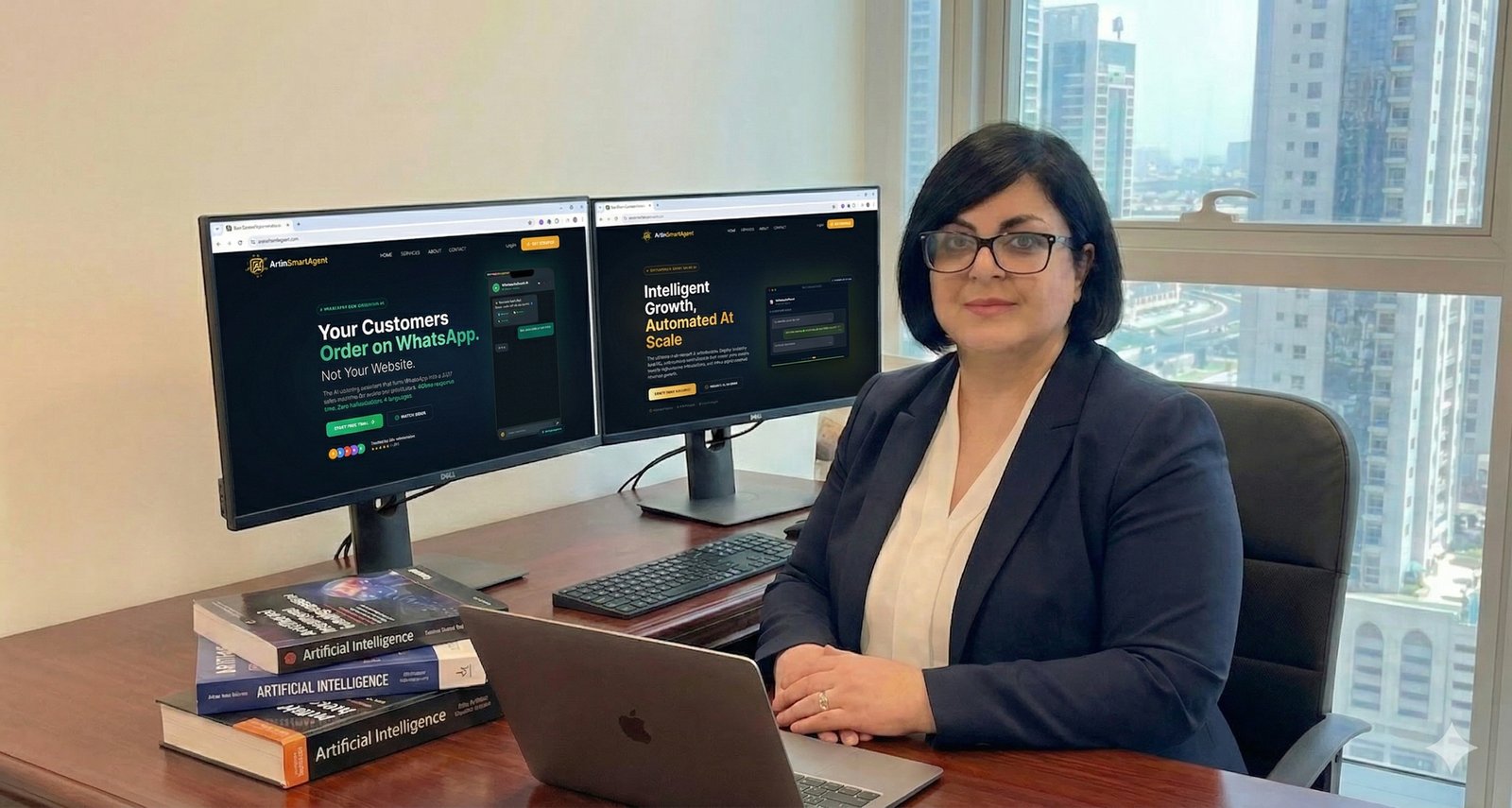
The desert wind whips through the towering skyscrapers of Dubai, carrying with it not just the scent of ambition but the hum of innovation. In a city that redefined what’s possible, businesses here are constantly looking for the next frontier, the edge that separates success from stagnation. For nearly two decades, I’ve had a front-row seat to this relentless pursuit, watching the digital landscape evolve from static websites to dynamic e-commerce, and now, to the truly transformative power of Artificial Intelligence. At ArtinWebs, we’ve ridden every wave, but none has felt as profound, as potentially revolutionary, as the rise of AI agents. This isn’t just about efficiency; it’s about reimagining the very fabric of how businesses operate, serve customers, and grow in the hyper-competitive, ever-evolving market of Dubai through advanced business process automation.
The Dubai Business Landscape: A Story of Growth and Challenge
Dubai is a city built on vision. From its humble beginnings as a trading port, it has morphed into a global hub for finance, tourism, and technology, attracting entrepreneurs and enterprises from every corner of the world. This meteoric rise, however, isn’t without its unique pressures. Businesses here operate at an accelerated pace, driven by a demanding, digitally-savvy consumer base and fierce competition. For ArtinWebs, our 18-year journey in this dynamic environment has been a masterclass in adaptability, evolving from crafting bespoke websites to deploying sophisticated AI automation solutions that redefine operational excellence.
The Founder’s Journey: From Early Automation to AI Vision
My journey, and that of ArtinWebs, began almost two decades ago, back when the internet was still a relatively nascent concept for many businesses in Dubai. We started with simple web development, helping local businesses establish their first digital footprints. Even then, the core challenge was efficiency. Clients, whether a burgeoning real estate developer or a family-owned trading company, constantly struggled with manual processes: managing inventory on spreadsheets, replying to customer inquiries via endless email chains, or coordinating sales teams with phone calls. Our initial forays into automation were rudimentary by today’s standards – perhaps a custom script to automate email sending or a simple database integration to streamline order processing. Yet, the relief these early efforts provided was palpable. Businesses saw immediate returns in time saved and errors reduced, confirming our belief that technology, applied strategically, could be a powerful lever for growth.
Over the years, we graduated to more complex systems: CRM integrations, ERP implementations, and full-fledged e-commerce platforms. We built WholesaleOS platform, for instance, to address the specific needs of B2B distributors in the region, bringing an unprecedented level of automation to ordering and inventory management. Each project was a step further into understanding the intricate workflows of Dubai businesses. However, a turning point arrived a few years ago. We observed that even the most robust traditional automation systems hit a wall when faced with unstructured data, complex decision-making, or the need for truly personalized, contextual interactions. That’s when AI, which had long been a theoretical concept discussed in tech circles, began to show practical promise. The vision for AI agents wasn’t born out of a trend, but out of a deep-seated need to push beyond the limits of rule-based automation, to empower businesses with autonomous entities capable of perception, reasoning, and intelligent action. We saw the opportunity to not just automate tasks, but to augment human capability, freeing our clients to focus on strategic growth and innovation, rather than getting bogged down in repetitive, albeit critical, operational minutiae.
Identifying the Bottlenecks: Why Traditional Methods Fall Short
In Dubai’s high-stakes business arena, time is literally money. Despite the city’s futuristic facade, many small to medium-sized businesses (SMBs) still grapple with astonishingly manual, time-consuming processes. One of the most common pain points we encounter is the exorbitant operational cost associated with human-intensive tasks. Consider a bustling automotive spare parts distributor in Al Quoz, managing thousands of SKUs and dozens of daily inquiries. Their customer service team is constantly overwhelmed, struggling to keep up with incoming calls, WhatsApp messages, and email queries. Each interaction is unique, requiring a human to sift through information, check stock, and provide quotes. This leads to slow response times, frustrated customers, and ultimately, lost sales.
Another prevalent challenge is inconsistent lead follow-up. A promising lead might come in through a website form at 2 AM, but the sales team only starts work at 9 AM. By then, the lead might have already contacted a competitor. Manual lead qualification and nurturing are not only inefficient but often lack the speed and consistency required to convert prospects in a market where immediate gratification is expected. We’ve seen countless scenarios where businesses invest heavily in marketing to generate leads, only to lose them due to sluggish or uncoordinated follow-up. Basic CRM systems help organize data, but they don’t *act* on it autonomously or intelligently engage prospects.
Furthermore, the demand for personalized experiences is skyrocketing. Customers in Dubai, whether B2B or B2C, expect tailored interactions, instant responses, and seamless service across multiple channels. Traditional methods, even with basic automation, simply cannot deliver this at scale. A simple chatbot might answer FAQs, but it falters when faced with nuanced questions or the need to access real-time, personalized customer data. The limitations of basic CRM/ERP systems become glaringly obvious when a business needs to dynamically adjust pricing based on market conditions, personalize marketing messages for segments of one, or proactively identify and resolve potential customer issues before they escalate. These are the intricate challenges that demand a new paradigm – one that AI agents are uniquely positioned to address for comprehensive business process automation.
Demystifying AI Agents: More Than Just Chatbots
The term “AI agent” often conjures images of science fiction, or at best, a glorified chatbot. But in the world of practical business automation, an AI agent is far more sophisticated, a true game-changer that transcends simple script-following. At ArtinWebs, we’ve spent years developing and refining these autonomous entities, witnessing firsthand their capacity to transform operations, especially within the unique context of Dubai’s dynamic business environment. Understanding what they are, and more importantly, what they are not, is the first step towards unlocking their immense potential for your business.
What Exactly is an AI Agent? Defining Autonomy and Purpose
At its core, an AI agent is an autonomous software entity designed to perceive its environment, make decisions based on its goals, and take actions to achieve those goals. Think of it less as a passive tool and more as a diligent, intelligent assistant that operates with a degree of independence. Unlike a traditional chatbot, which typically follows a rigid, predefined conversational flow, an AI agent possesses a deeper level of intelligence. It can adapt to new information, learn from interactions, and often engage in multi-step processes without constant human intervention.
Consider a real estate agency in Dubai, a sector where speed and accuracy are paramount. A traditional chatbot might help a prospect find available apartments based on predefined filters. An AI agent, however, could do much more. It could perceive an incoming inquiry (from WhatsApp, email, or website), understand the user’s intent (e.g., “I’m looking for a 2-bedroom apartment in Downtown Dubai with a budget of AED 150,000/year”), then autonomously check availability against a live property database, qualify the lead based on additional questions (e.g., “When are you looking to move?”, “Do you have any specific amenities in mind?”), and if suitable, even schedule a viewing with a human agent, automatically blocking out time in the agent’s calendar. It’s not just responding; it’s reasoning, planning, and executing. This goal-oriented behavior, adaptability, and ability to learn from past interactions are what truly distinguish AI agents and make them incredibly powerful tools for business process automation, especially in a market as competitive and fast-paced as Dubai.
The Spectrum of AI Agents: From Simple Bots to Complex Decision-Makers
The world of AI agents isn’t a monolithic block; it’s a rich spectrum of complexity and capability. On one end, you have reactive agents, which are the simplest. These agents act purely based on their current perception, without any memory of past events or explicit planning. An example might be a bot that detects a keyword in a customer message and immediately triggers a pre-set response. While basic, even these agents can significantly boost efficiency by handling specific, repetitive tasks, like providing instant answers to frequently asked questions about store opening hours or delivery statuses.
Moving up the ladder, we encounter deliberative agents. These agents maintain an internal model of their environment, allowing them to reason about future actions and consequences. They can plan a sequence of steps to achieve a goal, making them suitable for tasks requiring more complex decision-making. Imagine an agent that processes invoices: it doesn’t just scan for keywords but understands line items, reconciles them with purchase orders, flags discrepancies, and routes them for approval based on predefined rules. This level of sophistication begins to unlock real business process automation benefits, reducing errors and freeing up human staff from tedious reconciliation tasks.
At the pinnacle are multi-agent systems, where multiple AI agents collaborate to achieve a larger objective. For instance, in a large logistics company in Jebel Ali, one agent might monitor incoming orders, another optimizes delivery routes, and a third handles customer communication regarding delivery updates. These agents communicate and coordinate, creating a powerful, interconnected system that can manage complex, dynamic operations. The journey often begins with a simple, task-specific agent, solving an immediate pain point, and then evolves as businesses realize the potential to integrate these agents into more complex, interconnected systems that interact seamlessly with multiple platforms – from CRMs to inventory management systems, and even external APIs. This tiered approach allows businesses to start small, realize quick wins, and then incrementally scale their AI agent capabilities as their needs and understanding grow.
The ‘Aha!’ Moment: Realizing the Potential for Business Process Automation
For us at ArtinWebs, the true “aha!” moment with AI agents often comes when a client presents a problem that traditional automation simply can’t crack. I recall a specific instance with a prominent Dubai-based wholesale electronics distributor, a long-standing client. They had a sophisticated ERP system and even some basic automation in place for order processing. However, their sales team was drowning in requests for custom quotes, especially for bulk orders or unique product configurations. Each request involved checking multiple supplier databases, calculating tiered discounts, assessing freight costs for different regions (e.g., KSA vs. Oman), and then drafting a detailed, personalized quote – a process that could take hours, sometimes even a full day, for complex inquiries. This bottleneck was severely impacting their ability to respond quickly to market opportunities and provide competitive pricing.
Their existing system couldn’t handle the unstructured nature of the inquiries, the dynamic pricing variables, or the complex decision trees involved in crafting a truly competitive and accurate quote. This was a classic case for an AI agent. We designed an agent that could ingest an inquiry (whether via email, WhatsApp, or a web form), understand the product specifications and quantities using natural language processing (NLP), then autonomously query multiple supplier APIs for real-time pricing and stock. It would then apply a complex set of business rules for discounts, factoring in customer history, order volume, and destination-specific logistics. Finally, it would generate a professional, branded quote document and even initiate a follow-up email to the customer, all within minutes. The human sales team’s role shifted from manual data crunching to reviewing the AI-generated quotes, negotiating the final terms, and building relationships.
The immediate ROI was astonishing. The time taken to generate complex quotes plummeted from hours to minutes, allowing the sales team to process 3-4 times more inquiries daily. Lead conversion rates increased significantly because of the speed of response. More importantly, the accuracy of quotes improved, reducing costly errors. This wasn’t just automation; it was intelligent augmentation. The AI agent handled the dynamic, unstructured data and complex decision trees that baffled traditional systems, freeing the human team to focus on high-value activities – strategy, relationship building, and closing deals. This is the essence of AI agent power: taking over repetitive, rule-based, or even semi-cognitive tasks, and in doing so, unlocking unprecedented efficiency and growth for businesses in Dubai.
Building Your First AI Agent: A Practical AI Automation Tutorial
The idea of building an AI agent might seem daunting, reserved for large corporations with armies of data scientists. However, with the right methodology and tools, even SMBs in Dubai can harness this technology. At ArtinWebs, we believe in democratizing AI, providing practical, actionable steps to integrate intelligent automation into your business. This section serves as your practical guide, walking you through our proven approach to bringing your first AI agent to life.
Step-by-Step: From Problem Identification to Solution Design
The journey of building an effective AI agent always begins not with technology, but with a clear understanding of the business problem. Our methodology at ArtinWebs focuses on identifying tasks that are:
- Repetitive: Tasks performed frequently with similar inputs and outputs.
- Rule-Based: Tasks that follow a discernible set of rules, even if complex.
- Data-Intensive: Tasks that involve processing large volumes of information.
- Time-Consuming: Tasks that consume significant human hours but don’t necessarily require human creativity or empathy.
Common candidates in Dubai businesses include lead qualification, appointment scheduling for service industries, routine customer support (FAQs), data entry and validation, or even internal HR onboarding processes. For example, a logistics company in Al Quoz could identify the process of tracking shipments and providing status updates as an ideal candidate. Currently, this might involve a customer calling, a human agent looking up a tracking number in a system, and relaying information. An AI agent could automate this entirely.
Once a suitable task is identified, the next crucial step is to define clear objectives, scope, and success metrics. What exactly do you want the AI agent to achieve? Is it to reduce customer service call volume by 30%? To qualify 80% of incoming leads before they reach a human salesperson? To reduce data entry errors by 50%? Measurable outcomes are vital for demonstrating ROI. The scope defines the boundaries of the agent’s responsibilities – what it *will* and *will not* do. For the logistics company, the scope might be limited to providing tracking updates, not handling complex delivery disputes.
Finally, we move to designing the agent’s architecture. This involves outlining its four core components:
- Perception: How the agent receives information (e.g., reading an email, listening to a voice input, monitoring a database).
- Memory: Where the agent stores relevant information (e.g., customer history, product catalog, conversation context).
- Reasoning: The logic and intelligence that allows the agent to make decisions (e.g., rule sets, machine learning models).
- Action: How the agent interacts with its environment (e.g., sending an email, updating a CRM, triggering an API call).
A well-designed architecture ensures coherent operation, allowing the agent to perform its designated tasks seamlessly and effectively within your existing business ecosystem.
The Power of n8n Workflow Automation: Connecting the Dots
While the “brain” of an AI agent handles intelligence, it needs a nervous system to interact with the world. This is where AI automation services and tools like n8n come into play. n8n workflow automation (pronounced “n-eight-n”) is an incredibly powerful, open-source workflow automation tool that allows you to connect various services and APIs to build complex, automated workflows without extensive coding. Think of it as the ‘plumbing’ that enables your AI agent to perceive, act, and communicate across different platforms. It’s a low-code/no-code solution that empowers businesses in Dubai to integrate their CRM, email, messaging apps, databases, and custom applications with surprising ease.
Let’s consider a basic n8n workflow for a lead qualification AI agent.
- Trigger: An incoming message on WhatsApp (using the WhatsApp Business API node) or a new form submission on your website (using a Webhook node) acts as the trigger.
- Data Extraction & Processing: The AI agent (which might be a custom Python script or an OpenAI LLM integration) analyzes the message content to extract key information like name, contact details, and inquiry type. This processed data is then passed back to n8n.
- Conditional Logic: Based on the AI agent’s assessment (e.g., “Is this a qualified lead?”), n8n can use conditional nodes (“IF” statements) to branch the workflow.
- Action Execution:
- If qualified: Update your CRM (e.g., Salesforce, HubSpot node) with lead details, send an internal notification to the sales team (e.g., Slack node), and schedule a follow-up email to the customer (e.g., Gmail node).
- If not qualified: Send a polite automated response to the customer (WhatsApp node) and log the interaction for future analysis.
This simple example illustrates how n8n orchestrates the entire process. It allows your AI agent’s core logic to interact seamlessly with your existing tools, making it a central hub for your business process automation. It dramatically reduces the development time and complexity of integrating disparate systems, making advanced AI automation accessible even for businesses without a large in-house development team.
Crafting the Brain: Core Logic and Decision-Making
The “brain” of your AI agent is where the magic happens – its ability to reason and make decisions. There are several approaches to infusing an agent with intelligence, each suitable for different types of tasks:
- Rule-Based Systems: For tasks with clearly defined, deterministic rules (e.g., “If inquiry type is X, then send response Y”), a rule-based system is highly effective. These are explicit sets of ‘if-then’ statements.
- Machine Learning Models: For tasks requiring pattern recognition or prediction (e.g., classifying customer sentiment, predicting lead conversion), machine learning models (like supervised learning for classification or regression) can be trained on historical data.
- Large Language Models (LLMs): For tasks involving natural language understanding, generation, and complex reasoning (e.g., summarizing documents, crafting personalized emails, engaging in dynamic conversations), integrating with services like OpenAI’s GPT models is incredibly powerful.
Often, a hybrid approach yields the best results. For instance, an LLM might understand the user’s intent, then pass that intent to a rule-based system or a custom Python script that executes a specific business logic. When dealing with unique business logic or specific data transformations, custom Python scripts are invaluable. They allow for precise control and can handle complex computations that might be difficult to express purely through rules or prompts to an LLM.
Here’s a conceptual Python-like snippet illustrating how an agent might decide its next action based on input and internal state:
class LeadQualificationAgent:
    def __init__(self):
        self.knowledge_base = {
            "budget_threshold": 50000,
            "industry_focus": ["tech", "finance", "real estate"]
        }
        self.qualified_leads = []

    def perceive(self, lead_data):
        self.current_lead = lead_data
        print(f"Agent perceived: {lead_data}")

    def decide_action(self):
        if not self.current_lead:
            return "WAIT_FOR_INPUT"

        # Step 1: Check budget
        if self.current_lead.get("budget", 0) < self.knowledge_base["budget_threshold"]:
            return "SEND_NURTURING_EMAIL" # Too low budget for immediate sales

        # Step 2: Check industry fit
        if self.current_lead.get("industry") not in self.knowledge_base["industry_focus"]:
            return "SEND_GENERIC_INFO" # Not our target industry

        # Step 3: Check urgency (example of LLM output integration)
        if self.current_lead.get("urgency_score", 0) > 0.7: # urgency_score could come from an LLM analysis
            return "NOTIFY_SALES_IMMEDIATELY"
        else:
            return "SCHEDULE_FOLLOW_UP"

    def execute_action(self, action_type):
        if action_type == "NOTIFY_SALES_IMMEDIATELY":
            print(f"Action: Notifying sales for urgent lead: {self.current_lead['name']}")
            self.qualified_leads.append(self.current_lead)
            # In a real system, this would trigger an n8n workflow to send Slack/CRM update
        elif action_type == "SEND_NURTURING_EMAIL":
            print(f"Action: Sending nurturing email to {self.current_lead['email']}")
            # Trigger n8n workflow for email sending
        # ... other actions

# Example usage (simplified for illustration)
agent = LeadQualificationAgent()
agent.perceive({"name": "Ahmed", "email": "ahmed@example.com", "budget": 75000, "industry": "tech", "urgency_score": 0.8})
action = agent.decide_action()
agent.execute_action(action)

agent.perceive({"name": "Fatima", "email": "fatima@example.com", "budget": 30000, "industry": "retail", "urgency_score": 0.2})
action = agent.decide_action()
agent.execute_action(action)
This snippet demonstrates how an agent can take input, apply internal logic (rules, thresholds), and then decide on an appropriate action. The “urgency_score” could easily be generated by an LLM analyzing the sentiment and keywords in an initial customer message. This blend of structured logic and advanced AI capabilities forms the robust brain of a truly intelligent agent.
Real-World Impact: WhatsApp Business Bot Setup for Customer Engagement
In Dubai, WhatsApp isn’t just a messaging app; it’s a primary mode of business communication. From ordering groceries to inquiring about luxury real estate, customers expect instant, personalized interactions on this platform. This ubiquitous presence makes WhatsApp an incredibly fertile ground for AI agents to revolutionize customer service and lead qualification. At ArtinWebs, we’ve seen firsthand how a well-implemented WhatsApp Business bot setup, powered by intelligent AI agents, can transform engagement for our Dubai-based clients.
Use Case: Automating Customer Service and Lead Qualification in Dubai
Let’s consider a detailed case study from one of our clients, a rapidly growing luxury car dealership in Sheikh Zayed Road. Their sales team was constantly inundated with WhatsApp inquiries. Customers would ask about specific models, availability, pricing, financing options, and test drive appointments. The sheer volume meant delays, missed opportunities, and a significant drain on human resources, who often spent their time answering repetitive questions instead of focusing on high-value sales conversations.
We implemented an AI agent-powered WhatsApp Business bot setup for them. Here’s how it worked:
- Initial Inquiry Handling: When a customer messaged, the bot would instantly greet them and offer a menu of common inquiries (e.g., “Browse Models,” “Check Stock,” “Book Test Drive,” “Get Financing Info”).
- FAQ Automation: For general questions, the bot would access a comprehensive knowledge base, providing instant, accurate answers 24/7. This immediately offloaded about 40% of their customer service inquiries.
- Lead Qualification: If a customer expressed interest in a specific model, the bot would ask qualifying questions (e.g., “Are you looking for a new or pre-owned vehicle?”, “What’s your preferred budget range?”, “When are you planning to purchase?”). It would then use this information to score the lead.
- Real-time Stock Check & Pricing: The bot integrated with the dealership’s inventory system (via n8n) to provide real-time stock availability and preliminary pricing for specific models.
- Appointment Scheduling: For qualified leads interested in a test drive or showroom visit, the bot could access the sales team’s calendars and offer available slots, booking the appointment directly and sending a confirmation to both the customer and the sales agent.
The competitive advantage gained was enormous. The dealership could now provide instant, personalized responses at any time of day or night, dramatically improving customer satisfaction and engagement. Leads were qualified efficiently, ensuring that human sales agents only engaged with truly interested prospects, allowing them to focus on closing deals. This wasn’t just about saving costs; it was about elevating the customer experience and driving measurable sales growth in a highly competitive market like Dubai.
Curious how much an AI Agent could save your UAE business?
Calculate your exact Visa, Gratuity, and workspace savings compared to hiring a human.
Launch AI ROI CalculatorIntegrating with WhatsApp Business API: A Hands-On Walkthrough
Setting up a robust WhatsApp Business bot requires leveraging the WhatsApp Business API, not just the standard WhatsApp Business app. This is crucial for automation and scalability. Here’s a simplified overview of the process:
- Meta Business Manager Setup: You need a verified Facebook Business Manager account. This is where you’ll manage your WhatsApp Business Account, phone numbers, and message templates.
- WhatsApp Business Account & Phone Number: Apply for a WhatsApp Business Account and connect a phone number that will be dedicated to your bot. This number must be verified by Meta.
- Message Templates: WhatsApp requires businesses to use pre-approved message templates for outgoing messages to customers outside a 24-hour customer service window. These are essential for notifications, alerts, and proactive outreach. Examples include “Your order has been shipped!” or “Your appointment is confirmed.”
- Connecting to n8n: Once your WhatsApp Business API is set up, you’ll use an n8n WhatsApp node (or a custom webhook listener) to receive incoming messages.
# Conceptual n8n WhatsApp webhook setup: # 1. Add a 'Webhook' node in n8n. # 2. Configure it to listen for POST requests. # 3. Copy the Webhook URL provided by n8n. # 4. In Meta Developer settings for your WhatsApp Business Account, # set this n8n Webhook URL as your Callback URL for message events. # 5. Add a 'WhatsApp Business Cloud' node in n8n. # 6. Configure it with your Phone Number ID and Access Token from Meta. # 7. Connect the Webhook node to an 'Execute Command' node (for your AI agent logic) # and then to the WhatsApp Business Cloud node for sending replies. - Building the Workflow: Inside n8n, you’ll design the workflow. The incoming message from WhatsApp triggers the webhook. This data is then passed to your AI agent’s logic (e.g., a Python script or an OpenAI API call via an ‘HTTP Request’ node). The agent processes the message, decides on a response, and sends the response back to n8n. n8n then uses the WhatsApp Business Cloud node to send the reply message back to the customer.
This robust integration allows for real-time communication, media support (sending images, documents), and effective management of customer conversation sessions, ensuring a smooth and compliant experience. Mastering these steps is key to unlocking the full potential of WhatsApp Business bot setup for customer engagement in Dubai.
Beyond Basic Replies: Leveraging AI for Personalized Interactions
While basic FAQ bots are useful, the true power of an AI agent on WhatsApp lies in its ability to move beyond predefined scripts and engage in truly personalized, dynamic interactions. This is achieved by leveraging advanced Natural Language Understanding (NLU) and Natural Language Processing (NLP) techniques, often powered by Large Language Models (LLMs).
Instead of just matching keywords, an NLU-powered bot can understand the user’s intent, even if phrased in multiple ways. For example, “I want to know how much for the new sedan” and “What’s the price of the latest saloon model?” both convey the same intent: “Get Pricing.” This allows for more natural, free-flowing conversations. Furthermore, by integrating the WhatsApp bot with your CRM and other business systems (via n8n), the AI agent can personalize responses based on customer history, past purchases, stated preferences, or real-time data. Imagine a customer asking about their loyalty points. The bot can instantly retrieve that specific customer’s points balance from the CRM and provide an accurate, personalized update.
Beyond responding, AI agents can also be proactive. For a luxury fashion retailer in Dubai Mall, an AI agent could monitor customer purchase history. If a customer recently bought a specific designer handbag, the agent could proactively send a message a few weeks later, suggesting matching accessories (e.g., “Hi [Customer Name]! We noticed you recently acquired the new [Handbag Model]. Would you be interested in seeing our latest collection of matching scarves and wallets?”). This kind of dynamic content generation and proactive engagement significantly enhances the customer journey, fostering loyalty and driving repeat business. It transforms the WhatsApp channel from a mere support tool into a powerful, personalized marketing and sales engine, a capability that truly sets leading businesses apart in Dubai’s competitive retail landscape.
Scaling Your AI Agent Fleet: An AI Agent Development Guide for Growth
Once you’ve experienced the transformative power of a single AI agent, the next logical step for any ambitious Dubai business is to explore how this technology can be scaled across various departments and functions. The true strength of AI agents lies not just in isolated automation, but in their ability to form an interconnected fleet, streamlining operations, enhancing decision-making, and driving comprehensive growth across the entire enterprise. At ArtinWebs, we guide our clients through this expansion, ensuring that each new agent adds distinct value and integrates seamlessly into the existing digital ecosystem.
Expanding Beyond Customer Service: Internal Operations & Data Analysis
While customer service and lead generation are immediate and obvious applications, the utility of AI agents extends far beyond the front lines. Consider internal operations, which are often rife with manual, repetitive tasks that drain employee productivity. For a large construction firm in Dubai, HR onboarding can be a bureaucratic nightmare. An AI agent could automate the entire process: sending welcome kits, collecting necessary documents, initiating IT setup requests, scheduling initial training sessions, and ensuring compliance with local labor laws. This frees HR personnel to focus on employee engagement and strategic talent management, rather than administrative overhead.
In supply chain management for a trading company in Jebel Ali Free Zone, AI agents can monitor inventory levels, predict demand fluctuations based on historical data and market trends, automatically reorder stock from suppliers when thresholds are met, and even track shipments, flagging potential delays before they impact operations. For financial reporting, an agent can gather data from various accounting systems, generate summary reports, identify anomalies, and even prepare preliminary budget forecasts, providing invaluable insights to management. We’ve seen Dubai companies use internal AI agents to streamline everything from expense report processing to marketing campaign optimization, reducing errors, increasing throughput, and enabling faster, more informed decision-making. These agents don’t just save time; they provide a strategic advantage by transforming raw data into actionable intelligence. For instance, our B2B Smart Ordering solution leverages AI to optimize order processing and inventory for wholesale businesses, showcasing how AI agents can revolutionize core operational areas.
Monitoring and Iteration: The Continuous Improvement Loop
Deploying an AI agent is not a one-time event; it’s the beginning of a continuous improvement journey. Robust monitoring tools and analytics are absolutely critical for evaluating the agent’s performance and ensuring it consistently meets its objectives. For our clients, we implement dashboards that track key metrics such as:
- Response Time: How quickly the agent processes inputs and delivers outputs.
- Accuracy: The percentage of tasks completed correctly or responses provided accurately.
- Task Completion Rate: How often the agent successfully completes a defined task without human intervention.
- Escalation Rate: How frequently the agent needs to hand over to a human (an indicator of where its intelligence might need improvement).
- User Satisfaction: Collected through simple feedback mechanisms (e.g., “Was this helpful?”).
These metrics provide invaluable insights into the agent’s effectiveness and highlight areas for refinement. Strategies for collecting user feedback – both explicit (surveys, ratings) and implicit (conversation analysis, sentiment detection) – are integrated into the workflow. For example, if a WhatsApp bot consistently fails to answer questions about a specific product category, it indicates a gap in its knowledge base or NLU capabilities.
The iterative process of refining AI agent logic, training data, and workflow automations is paramount. This might involve:
- Updating Knowledge Bases: Adding new FAQs or product information.
- Improving NLU Models: Providing more training data to help the agent better understand nuanced queries.
- Adjusting Decision Trees: Fine-tuning the rules that guide the agent’s actions.
- Optimizing Integrations: Ensuring seamless data flow between the agent and other systems.
This continuous feedback loop ensures that your AI agents remain highly efficient, accurate, and aligned with your evolving business needs, maximizing their ROI over time. It’s an ongoing partnership between human oversight and autonomous operation.
Best Practices for Secure and Ethical AI Agent Deployment
As AI agents become more deeply embedded in business operations, addressing issues of security, privacy, and ethics is not just good practice – it’s a critical imperative, especially in a region like the UAE where data protection regulations are evolving. At ArtinWebs, we prioritize these considerations in every AI agent development project:
- Data Privacy & Security: All data handled by AI agents must comply with relevant regulations, including international standards like GDPR (where applicable for international clients) and local UAE data protection laws. This means implementing robust encryption for data at rest and in transit, strict access controls, and anonymization techniques where personal data is not strictly required for the agent’s function. For instance, when processing customer inquiries, we ensure that sensitive information is only stored in secure, compliant databases.
- Transparency with Users: It’s crucial to be transparent with users that they are interacting with an AI agent. This builds trust and manages expectations. A simple “Hello, I’m [Agent Name], your AI assistant from [Company Name]” at the start of an interaction is often sufficient. This avoids confusion and ensures customers understand the nature of their interaction.
- Mitigating Biases: AI models, particularly those trained on large datasets, can inadvertently learn and perpetuate biases present in that data. This can lead to unfair or discriminatory outcomes. We employ rigorous testing and validation processes to identify and mitigate biases in AI models, ensuring fair and equitable outcomes for all users and processes. For example, in a lead qualification agent, we ensure that the qualification criteria are based purely on business relevance, not on demographic or other potentially biased factors.
- Accountability and Human Oversight: While AI agents are autonomous, they are not absolved of accountability. Clear guidelines must be established for human oversight, intervention, and responsibility when an AI agent makes an error or encounters an unforeseen scenario. There should always be a clear path for human escalation.
By adhering to these best practices, businesses in Dubai can deploy AI agents with confidence, ensuring they are not only efficient and effective but also trustworthy, secure, and ethical members of their operational team.
The Future is Autonomous: What’s Next for Dubai Businesses
The pace of change in Dubai is relentless, and the evolution of AI agents is accelerating at an equally dizzying speed. What we see today is merely the dawn of an era where intelligent automation will become an integral, invisible layer across every facet of business. For businesses in Dubai, understanding this trajectory isn’t just about staying competitive; it’s about proactively shaping their future in a market that rewards foresight and innovation. At ArtinWebs, we’re not just building AI agents; we’re helping our clients prepare for, and thrive in, this autonomous future.
Predicting the Evolution of AI Agents and the Workforce
The next generation of AI agents will be characterized by even greater autonomy, proactive capabilities, and collaborative intelligence. We’re moving towards agents that can not only react to inputs but anticipate needs, initiate actions without explicit prompts, and work seamlessly alongside other agents and human teams. Imagine an AI agent in a logistics company that doesn’t just track shipments but proactively reroutes them in real-time when traffic jams or weather disruptions are detected, notifying all stakeholders automatically. Or an agent that identifies a potential customer churn risk based on usage patterns and autonomously crafts a personalized retention offer, coordinating with the marketing and sales departments.
This evolution will naturally reshape the workforce. The fear that AI agents will simply replace human jobs is a narrow view. Instead, the role of human employees will evolve towards higher-value tasks, creativity, strategic oversight, and complex problem-solving that still requires human intuition and empathy. Routine, repetitive, and data-heavy tasks will increasingly be offloaded to AI agents, freeing human talent to focus on innovation, customer relationships, and strategic growth. Businesses in Dubai must prepare for this future by investing in upskilling their workforce, fostering a culture of continuous learning, and embracing the concept of hybrid human-AI teams. The competitive edge will belong to those who master the art of synergistic collaboration between human intelligence and artificial intelligence, leveraging each for its unique strengths.
ArtinWebs’ Vision: Empowering Businesses with Intelligent Automation
At ArtinWebs, our commitment to bringing cutting-edge AI automation to Dubai businesses remains unwavering. Our vision extends beyond merely implementing technology; it’s about fostering a culture of innovation and sustainable growth for our clients. We believe that every business, regardless of size, deserves access to transformative AI solutions that can elevate their operations and competitive standing. We’re constantly exploring emerging AI technologies – from advanced LLM fine-tuning to multi-modal AI and explainable AI (XAI) – to integrate them into practical, real-world applications for the Dubai market.
Our future vision for client partnerships involves developing even more sophisticated, custom-tailored solutions that address highly specific business challenges. This isn’t about shoehorning a generic AI product into a business; it’s about understanding the unique workflows, market dynamics, and strategic objectives of each client and then engineering bespoke AI agent systems that deliver precise, measurable value. Whether it’s optimizing complex supply chains for a large retailer, personalizing customer journeys for a tourism operator, or streamlining regulatory compliance for a financial service provider, ArtinWebs aims to be the trusted partner that empowers Dubai businesses to embrace the autonomous future with confidence. Our expertise ensures that AI agents are not just tools, but strategic assets that redefine possibilities.
Your Call to Action: Starting Your AI Automation Journey Today
The future of business in Dubai is undeniably intertwined with intelligent automation. The question is no longer “if” you should embrace AI agents, but “when” and “how.” The time to act is now. We encourage every SMB owner reading this to take a critical look at their current processes. Where are the bottlenecks? Which tasks consume excessive human hours without adding strategic value? Where are you losing leads or frustrating customers due to slow responses? These are the prime opportunities for AI automation.
Don’t let the perceived complexity of AI deter you. With ArtinWebs, you have a partner with 18+ years of experience navigating Dubai’s unique business landscape, ready to guide you through every step of your AI automation journey. We offer personalized consultations to assess your specific needs, identify the most impactful automation opportunities, and design a tailored AI agent implementation plan that delivers tangible results. Investing in AI agents today means securing a long-term advantage: sustainable growth, significantly increased efficiency, enhanced customer satisfaction, and an undeniable competitive edge in the dynamic Dubai market. Let’s start building your autonomous future together. Contact ArtinWebs to discuss your AI automation project today.
Frequently Asked Questions about AI Automation & AI Agents
What is an AI agent and how is it different from a chatbot?
An AI agent is an autonomous software entity designed to perceive its environment, make decisions based on its goals, and take actions to achieve those goals. Unlike a traditional chatbot, which typically follows rigid, predefined conversational flows, an AI agent possesses deeper intelligence, can adapt to new information, learn from interactions, and often engage in multi-step processes without constant human intervention. It’s capable of reasoning, planning, and executing complex tasks, making it a powerful tool for business process automation.
How can AI automation benefit my business in Dubai?
AI automation can significantly benefit Dubai businesses by reducing operational costs, improving response times, enhancing customer satisfaction through personalized interactions, and freeing human staff from repetitive tasks to focus on strategic growth. Specific benefits include efficient lead qualification, 24/7 customer service via WhatsApp Business bots, streamlined internal operations, and data-driven decision-making, all contributing to a stronger competitive edge in Dubai’s fast-paced market.
What is n8n and why is it important for AI agent development?
n8n is an open-source, low-code/no-code workflow automation tool that acts as the ‘nervous system’ for your AI agents. It allows you to connect various services and APIs (like CRM, email, WhatsApp Business API, databases, and custom applications) to build complex, automated workflows. For AI agent development, n8n is crucial because it enables the AI agent’s core logic to seamlessly interact with your existing business tools, orchestrating data flow and action execution across disparate platforms, thus making advanced AI automation accessible and efficient.
Can I set up a WhatsApp Business bot for my Dubai business?
Yes, absolutely. Setting up a WhatsApp Business bot is a highly effective strategy for customer engagement in Dubai. By leveraging the WhatsApp Business API and integrating it with an AI agent (often orchestrated via n8n), your business can automate customer service, qualify leads, provide real-time information (like stock checks or pricing), and even schedule appointments. This allows for instant, personalized responses 24/7, significantly improving customer experience and operational efficiency.
What are the first steps to start my AI automation journey with ArtinWebs?
The first step is to identify bottlenecks and repetitive, time-consuming tasks within your business that could benefit from automation. ArtinWebs offers personalized consultations to assess your specific needs, identify the most impactful AI automation opportunities, and design a tailored AI agent implementation plan. We guide you through problem identification, solution design, technology integration (including n8n and WhatsApp Business bot setup), and continuous improvement, ensuring tangible results and a strong return on investment.