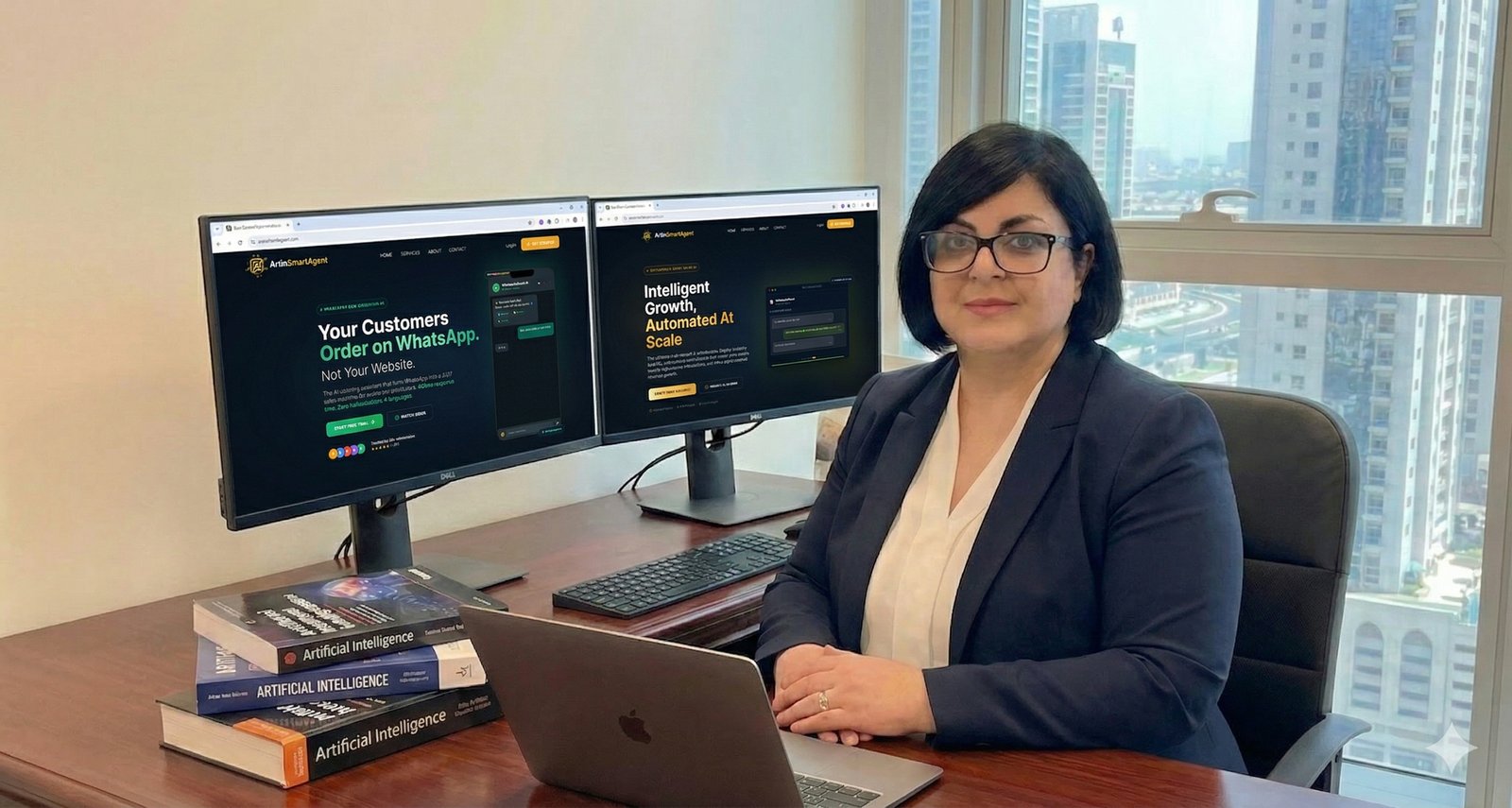
The sun beats down on Sheikh Zayed Road, a relentless testament to Dubai’s ambition. For nearly two decades, I’ve watched this city evolve at warp speed, from a regional hub to a global powerhouse of innovation. My journey with ArtinWebs.com began much like many of your businesses – with a vision, a lot of hard work, and a constant search for an edge. We’ve seen countless SMBs rise and fall, and one truth has become undeniable: the businesses that thrive are those that embrace change, those that aren’t afraid to automate, and those that leverage intelligence to outpace the competition. This isn’t just about adopting new tech; it’s about fundamentally reshaping how you operate, how you connect, and how you conquer the unique challenges of the Dubai market.
Introduction: The Dubai Dream and the Automation Imperative
From Humble Beginnings to Digital Transformation: Our Journey in Dubai
Dubai’s business landscape is a relentless, exhilarating marathon. Every day, new entrants arrive, eager to carve out their niche, fueled by ambition and the city’s boundless opportunities. When I started ArtinWebs.com over 18 years ago, the challenges for small and medium-sized businesses were distinct, yet some fundamental struggles persist: how do you scale without spiraling costs? How do you maintain efficiency when demand surges? And how do you genuinely engage with customers in a market saturated with options? For years, we’ve partnered with local businesses, from bustling F&B suppliers in Al Quoz to high-tech service providers in Dubai Internet City, helping them navigate these exact questions.
I recall an early client, a wholesale distributor dealing with fresh produce. Their entire operation, from order taking to delivery scheduling and invoicing, was a flurry of phone calls, WhatsApp messages, and handwritten notes. The owner, a seasoned entrepreneur, was constantly bogged down in manual tasks, unable to focus on strategic growth. This scenario, I quickly learned, was not an anomaly but the norm for many SMBs here. The ambition was there, the market was ripe, but the operational backbone was fragile, built on human effort alone. It became clear to me that for businesses in Dubai to truly flourish, they needed more than just a website or a social media presence; they needed a fundamental shift in how they managed their day-to-day. They needed intelligence woven into their operations, a system that could handle the mundane with precision, freeing human potential for innovation and relationship building. This realization became the bedrock of ArtinWebs: AI automation isn’t merely a trend; it is the essential operational backbone for modern businesses, especially in a dynamic, high-growth environment like Dubai. It’s about building a digital infrastructure that allows you to dream bigger, act faster, and serve better, without being overwhelmed by the very success you’re striving for.
The Silent Revolution: Why AI Automation is No Longer a Luxury
The shift we’ve witnessed in Dubai is profound, moving from reactive, manual processes to proactive, intelligent operations. Think about the way traditional businesses used to operate: a customer calls, an employee answers, takes notes, enters data, perhaps follows up later. Every step a potential point of failure, a drain on time, and a bottleneck to growth. Now, imagine a system where that initial call or message is handled instantly, intelligently routed, data is captured automatically, and follow-up actions are triggered without human intervention. This isn’t science fiction; it’s the reality for businesses that have embraced AI automation.
We often talk about the concept of an “Operative” – a unified, automated platform that isn’t just a collection of tools but a cohesive intelligence overseeing and optimizing various aspects of your business. It’s like having a highly efficient, tireless, digital team member working 24/7. Consider the advertising and broadcast management industry, a sector we’ve worked extensively with. Historically, managing ad placements, scheduling, campaign performance, and client communication involved intricate manual coordination, prone to errors and delays. With a unified automation platform, these complex processes transform. Campaigns are scheduled and optimized automatically based on real-time data, client reports are generated instantly, and invoicing is streamlined. This “Operative” approach ensures consistency, reduces human error, and allows the human team to focus on creative strategy and client relationships, rather than administrative overhead. For an SMB in Dubai, whether you’re in logistics, retail, or professional services, this means moving beyond just putting out fires to strategically preventing them, identifying opportunities, and consistently delivering a superior experience. Throughout this article, I’ll share practical, real-world examples from the Dubai B2B market, showing you precisely how these shifts have played out for our clients, offering not just theory but actionable insights that you can implement in your own business. It’s time to stop thinking of AI as a futuristic concept and start integrating it as an essential, immediate component of your business process automation strategy.
Chapter 1: The Unseen Costs – Why Business Process Automation is Your First Step to Transformation
Identifying Your Operational Bottlenecks: A Dubai SMB Case Study
Let me tell you about “Falcon Logistics,” a mid-sized freight forwarding company based in Jebel Ali Free Zone, a client we started working with about two years ago. When we first met their founder, Mr. Ahmed, he was visibly stressed. His team was overwhelmed, working long hours, yet struggling to keep up with the increasing volume of inquiries and shipments. Their workflow was a textbook example of manual inefficiency. Leads came in via email, phone, and even LinkedIn messages, all of which were manually logged into a basic Excel sheet. Sales representatives spent hours qualifying these leads, often missing critical information or delaying responses, leading to lost opportunities. Once a client was onboarded, every single document – shipping manifests, customs declarations, invoices – required manual data entry, often multiple times across different systems. Scheduling pickups and deliveries was a chaotic dance of phone calls and WhatsApp messages between drivers, warehouse staff, and clients, frequently resulting in miscommunications and delayed shipments. Mr. Ahmed showed us stacks of paper invoices waiting for approval, a process that could take days, impacting cash flow.
The true cost of these manual processes wasn’t just the visible overtime pay or the occasional penalty for a delayed delivery. It was the hidden drain: the constant risk of human error leading to incorrect bookings or pricing, the slow response times that alienated potential high-value clients, the sheer mental fatigue of his team, and most importantly, Mr. Ahmed’s inability to step back and strategically grow his business. He was trapped *in* the business, not *on* it. The “aha!” moment for him came during a particularly bad week when a crucial shipment to Saudi Arabia was delayed due to a missed email, costing them a significant client. That’s when he realized the true, quantifiable cost of *not* embracing robust AI automation services and business process automation. It wasn’t just about saving money; it was about saving his business’s reputation, his team’s morale, and his own sanity.
Practical Tip: Conduct an Internal Audit of Repetitive Tasks
Before you automate, you must identify what needs automating. Gather your team for a brainstorming session. List every task that is:
- Repetitive: Done daily, weekly, or monthly with little variation (e.g., data entry, report generation, basic customer inquiries).
- Time-Consuming: Tasks that eat up significant hours from your team, preventing them from focusing on higher-value activities.
- Prone to Error: Where manual input frequently leads to mistakes (e.g., invoicing, inventory updates).
- A Bottleneck: Processes that consistently slow down the entire workflow.
Prioritize tasks based on their impact on cost, customer satisfaction, and employee morale. Start with the “low-hanging fruit” – tasks that are easy to automate and promise quick, visible wins.
Designing Your First Automation Blueprint: From Chaos to Clarity
Understanding the pain points is just the beginning; the next step is to envision a streamlined future. Business process automation (BPA) isn’t merely about plugging in a tool; it’s a strategic framework that requires careful planning. It’s about deconstructing your current operations and rebuilding them with intelligence at their core. For Falcon Logistics, we decided to tackle their new client onboarding process first – a critical, yet highly manual, sequence of events.
Here’s a simplified step-by-step guide we followed to map out their first automation blueprint:
- Define the Process Scope: We focused specifically on “New Client Inquiry to First Quote.”
- Map the Current State: We diagrammed every step Mr. Ahmed’s team took, noting who did what, which tools were used (or not used), and where delays occurred. This involved a lot of sticky notes and whiteboard drawings.
- Identify Automation Opportunities: For Falcon Logistics, this included:
- Automated lead capture from various sources (website form, WhatsApp, email).
- Automated initial lead qualification (e.g., asking basic business details).
- Automated CRM entry and task assignment to a sales rep.
- Automated initial email/WhatsApp follow-up with a brochure or service catalog.
- Design the Future State: We then drew out the ideal, automated workflow. Instead of manual data entry, a web form submission would directly populate the CRM. Instead of a sales rep manually sending a welcome email, the CRM would trigger it automatically.
- Select the Right Tools: We opted for a combination of a robust CRM, a WhatsApp Business API integration, and an integration platform like n8n (which we’ll delve into later) to connect these systems.
- Implement Iteratively: We didn’t try to automate everything at once. We started with lead capture and CRM entry. Once that was stable and providing value, we moved to automated follow-ups. This iterative approach allowed Mr. Ahmed’s team to adapt gradually, see quick wins, and build confidence in the new systems.
The key is to start small. Don’t aim for a complete overhaul immediately. A simple automation, like automatically adding new website inquiries to your CRM and sending an instant acknowledgement, can save hours per week and significantly improve response times. These quick wins build momentum and demonstrate the tangible benefits of BPA, making it easier to gain internal buy-in for larger-scale projects. By treating BPA as a strategic framework, you move from reactive problem-solving to proactive, intelligent operations, laying a robust foundation for sustainable growth in the competitive Dubai market.
Chapter 2: Beyond the Buzz – Crafting a WhatsApp Business Bot Setup That Truly Connects
The Power of Proximity: Why WhatsApp is King in the UAE B2B Landscape
In Dubai, if you want to reach someone, you WhatsApp them. It’s as simple and as profound as that. I remember working with a boutique real estate agency in Business Bay, “Horizon Properties.” Their sales team was constantly tethered to their phones, juggling calls, emails, and an endless stream of WhatsApp messages from prospective buyers and renters. They were trying their best to provide personalized service, but the sheer volume was overwhelming. Leads would often go cold because a sales agent was busy on another call, and by the time they replied manually, the prospect had already moved on. The owner, Ms. Fatima, was frustrated. “We’re missing out,” she told me, “Our clients expect instant responses, and we just can’t keep up, even with a dedicated team.”
This wasn’t an isolated incident. In the UAE, WhatsApp isn’t just a messaging app; it’s the primary mode of communication for everything from social interactions to critical business negotiations. Its ubiquity means that for B2B businesses, it’s a direct, informal, and highly effective channel for lead generation, customer support, and even sales. Customers here expect immediate, personalized engagement. Manual WhatsApp communication, however, quickly becomes a bottleneck for any growing business. Agents spend valuable time answering repetitive FAQs, qualifying leads, or providing basic information that could easily be automated. This is where a strategic WhatsApp business bot setup transforms a limitation into a powerful asset. It allows you to meet your customers where they are, providing that coveted instant response, but at scale and with consistent quality, without burning out your human team. It’s about leveraging the cultural communication preference of the UAE to your distinct business advantage, ensuring that no lead is left waiting and no customer query goes unanswered, regardless of the time of day.
Your 24/7 Digital Concierge: A Practical WhatsApp Business Bot Setup Guide
Building an effective WhatsApp Business Bot isn’t just about auto-replies; it’s about designing a seamless, intelligent user journey. Here’s how we helped Horizon Properties implement their 24/7 digital concierge:
- Define Bot’s Mission & Core Functions: For Horizon Properties, the bot’s mission was clear:
- Greet new inquiries and provide basic information about properties.
- Qualify leads (budget, property type, location preference).
- Book viewing appointments.
- Provide status updates for existing clients (e.g., tenancy renewal reminders).
- Route complex queries to human agents.
- Design Conversational Flows: We mapped out decision trees for each core function.
- Greeting: “Hello! Welcome to Horizon Properties. How can I assist you today? (1) Find a property (2) Book a viewing (3) General Inquiry.”
- Lead Qualification (Option 1): If ‘Find a property’ is selected: “Great! Are you looking to (1) Buy or (2) Rent? What’s your approximate budget? Which area are you interested in?” The bot uses quick-reply buttons to guide the user.
- Appointment Booking (Option 2): If ‘Book a viewing’ is selected: “Sure! Please provide your preferred date and time, and the property ID if you have one.” The bot then checks availability via an API integration.
- Integrate with Existing Systems: This is crucial. For Horizon Properties, the bot was integrated with their CRM (HubSpot) and their calendar management system.
- When a lead is qualified, their details (name, contact, preferences) are automatically pushed to HubSpot, creating a new lead entry and assigning it to the appropriate sales agent.
- When an appointment is booked, the bot creates a calendar event and sends a confirmation to both the client and the agent.
- When a client asks for a tenancy renewal reminder, the bot pulls data from their property management software and provides relevant details.
- Implement Human Handover: For complex questions or when a client requests to speak to a human, the bot seamlessly routes the conversation to a live agent within the CRM’s chat interface.
Workflow Example (Pseudo-code for a simple inquiry bot):
# WhatsApp Bot Logic - Inquiry Handling

def handle_whatsapp_message(message_text, user_id):
    if "hello" in message_text.lower() or "hi" in message_text.lower():
        send_message(user_id, "Welcome to ArtinWebs! How can I help you today?\n1. Learn about AI Automation\n2. Request a Consultation\n3. General Inquiry")

    elif "1" in message_text: # Learn about AI Automation
        send_message(user_id, "Great choice! We offer AI automation for various business processes. What specifically are you interested in?\n(e.g., WhatsApp Bots, n8n workflows, AI Agents)")
        # Store user's intent to guide next response
        set_user_context(user_id, "learning_ai")

    elif "2" in message_text: # Request a Consultation
        send_message(user_id, "Excellent! Please share your company name and a brief description of your automation needs, and we'll connect you with an expert.")
        set_user_context(user_id, "request_consultation")

    elif "3" in message_text: # General Inquiry
        send_message(user_id, "Please type your question, and I'll do my best to answer. If it's complex, I can connect you to a human agent.")
        set_user_context(user_id, "general_inquiry")

    elif get_user_context(user_id) == "learning_ai":
        if "whatsapp bots" in message_text.lower():
            send_message(user_id, "Our WhatsApp Business Bots can automate customer support, lead qualification, and appointment booking. Would you like a case study?")
        elif "n8n" in message_text.lower() or "workflows" in message_text.lower():
            send_message(user_id, "n8n workflow automation helps integrate all your tools for seamless data flow. We can build custom solutions for you.")
        else:
            send_message(user_id, "I can tell you more about specific AI automation topics. What aspect interests you most?")

    elif get_user_context(user_id) == "request_consultation":
        # Process company name and needs, push to CRM
        company_name, needs = extract_info(message_text)
        crm_api.create_lead(user_id, company_name, needs, "WhatsApp Bot Lead")
        send_message(user_id, "Thank you! Your request has been forwarded to our team. We'll be in touch shortly.")
        clear_user_context(user_id)

    elif "human" in message_text.lower() or "agent" in message_text.lower():
        send_message(user_id, "Connecting you to a human agent now. Please wait a moment.")
        handover_to_human_agent(user_id)

    else:
        send_message(user_id, "I'm sorry, I didn't quite understand. Could you please rephrase, or type 'human' to speak with an agent?")
This WhatsApp business bot setup drastically reduced the initial workload for Horizon Properties’ sales team, ensuring no lead was missed and significantly improving their response times. It’s about being present and responsive, 24/7, which is a massive competitive advantage in Dubai.
Measuring Bot Performance and Continuous Improvement
Deploying a WhatsApp bot is not a ‘set it and forget it’ operation. To truly unlock its value, you need to continuously monitor and refine its performance. For Horizon Properties, we tracked several key metrics:
- Response Rate: How quickly the bot engaged with new inquiries (aiming for instant).
- Resolution Time: How long it took the bot to answer a query or complete a task (e.g., qualify a lead, book an appointment).
- Customer Satisfaction (CSAT) Scores: Often collected through a quick post-interaction survey (e.g., “Did I answer your question? Rate 1-5”).
- Lead Conversion Rates: The percentage of bot-qualified leads that eventually converted into actual clients.
- Human Handover Rate: How often the bot needed to transfer to a human, indicating areas where the bot’s capabilities could be improved.
We regularly reviewed these metrics. For instance, if the human handover rate for “property details” was high, it meant the bot needed more robust information or better ways to access it. We used user feedback to refine bot scripts, improve its natural language understanding (NLU) by adding more variations of common questions, and enhance features like integrating with new property listings automatically. The goal is iterative improvement. The bot learns and grows with your business, becoming an increasingly sophisticated and invaluable part of your customer engagement strategy. Ensuring a smooth human handover option is paramount; the bot should augment, not frustrate, the customer experience, providing a safety net for complex or sensitive queries that require the nuanced touch of a human expert.
Chapter 3: The Digital Weaver – Unlocking Seamless Workflows with n8n Workflow Automation
Beyond Point Solutions: The Need for Holistic Integration
Many businesses in Dubai invest in excellent individual software solutions – a fantastic CRM like Salesforce, a powerful marketing automation tool like Mailchimp, a robust accounting system like Zoho Books, and perhaps a custom inventory management system. Each serves its purpose brilliantly. However, the problem arises when these systems don’t talk to each other. I recall a client, “Desert Spices,” a wholesale food distributor in Ras Al Khor. They had all these great tools, but their sales team was manually updating customer details from the CRM into the email marketing platform, then manually entering orders from emails into the inventory system, and finally, their accounts team was manually creating invoices in Zoho Books. This wasn’t just inefficient; it was a recipe for disaster. Data silos meant the marketing team couldn’t segment customers based on purchase history, sales reps didn’t know if an item was in stock without calling the warehouse, and the accounting team was constantly chasing missing order details. They were losing hours every day to manual reconciliation and rectification of errors.
This is the classic challenge of disconnected systems, and it leads to data inconsistencies, missed opportunities, and immense frustration. Traditional integration solutions can be expensive, complex, and often require specialized coding. This is where ‘n8n workflow automation‘ emerges as a game-changer. n8n is a powerful, flexible, and open-source alternative that allows businesses to connect disparate applications and automate workflows without being locked into proprietary ecosystems. What makes n8n particularly appealing for data-conscious Dubai businesses is its flexibility: it can be self-hosted, giving you complete control over your data and infrastructure, or used in a cloud-flexible manner. This level of customization and control is highly valued in a region where data privacy and sovereignty are increasingly important considerations. It allows businesses like Desert Spices to weave together their digital tools into a single, cohesive tapestry, ensuring data flows seamlessly, operations run smoothly, and the entire business acts as a unified, intelligent entity.
Building Your First n8n Workflow: A Real-World Example from Dubai B2B
Let’s walk through a practical ‘n8n workflow automation tutorial‘ for a common business scenario that would have greatly benefited Desert Spices: automatically adding new WhatsApp leads to their CRM, enriching their data, and sending a personalized follow-up email.
Scenario: New WhatsApp Lead to CRM & Personalized Email
- Trigger: New WhatsApp Message (Webhook)
- Your n8n workflow starts with a ‘Webhook’ node. This node listens for incoming messages from your WhatsApp Business API (or a WhatsApp bot platform integrated with n8n). When a new lead messages your WhatsApp number, it triggers the workflow.
- Data Extraction & Initial Processing (Function Node)
- Once the message is received, a ‘Function’ node can extract key information like the user’s phone number, name (if provided by the bot), and initial inquiry.
- Example: Parse the incoming JSON payload from WhatsApp to get `phone_number` and `message_text`.
- Check for Existing Lead in CRM (CRM Node – e.g., HubSpot, Zoho)
- A ‘CRM’ node (e.g., HubSpot, Zoho CRM) is used to check if a contact with this phone number already exists. This prevents duplicate entries.
- Logic: Search contacts by phone number.
- Conditional Logic (IF Node)
- An ‘IF’ node evaluates the result from the CRM search.
- IF (Contact Does NOT Exist): Proceed to create a new lead.
- IF (Contact EXISTS): Update the existing lead with new interaction details.
- An ‘IF’ node evaluates the result from the CRM search.
- Create/Update Lead in CRM (CRM Node)
- If it’s a new lead, another ‘CRM’ node creates a new contact, populating fields like ‘Phone Number’, ‘Source (WhatsApp)’, and ‘Initial Inquiry’.
- If it’s an existing lead, this node updates their activity log.
- Data Enrichment (HTTP Request / External API Node)
- This is where n8n shines. You can use an ‘HTTP Request’ node to connect to external services. For Desert Spices, we might use a company lookup API (like Clearbit or even a custom internal database) to enrich the lead’s data based on their company name (if provided). This could pull in industry, company size, website URL, etc.
- Example: Send `company_name` to `https://api.companylookup.com/v1/enrich`.
- Send Personalized Follow-Up Email (Email Sender Node – e.g., SMTP, SendGrid)
- Finally, an ‘Email Sender’ node is used to send a personalized welcome email. This email can dynamically pull in the lead’s name, company, and even reference their initial inquiry, making it highly relevant.
- Example Email Body (using n8n expressions): “Dear {{ $json.crmData.firstName | default: ‘Valued Customer’ }}, Thank you for reaching out to Desert Spices via WhatsApp! We received your inquiry about {{ $json.whatsappData.initialInquiry }}. Our team will be in touch shortly to discuss your needs for {{ $json.enrichedData.industry | default: ‘wholesale spices’ }}.”
Visualizing the Workflow:
Trigger (WhatsApp Webhook)
↓
Function (Extract Data)
↓
CRM (Search Contact)
↓
IF (Contact Exists?)
├─ NO (New Contact Path)
│ ↓
│ CRM (Create Contact)
├─ YES (Existing Contact Path)
│ ↓
│ CRM (Update Contact Activity)
↓ (Merge Paths)
HTTP Request (Data Enrichment)
↓
Email Sender (Personalized Follow-up)
Practical Tip: Leverage n8n’s Community and Nodes
n8n boasts an incredibly active community and a vast library of pre-built nodes for popular services (CRMs, marketing tools, databases, etc.). Don’t reinvent the wheel! Explore the community forums for similar workflows, use the extensive documentation, and leverage existing nodes to rapidly deploy your custom integrations. This reduces development time and allows you to focus on the unique logic of your business processes.
Advanced n8n Strategies: Data Enrichment and Conditional Logic
The true power of n8n extends far beyond simple integrations. Its robust capabilities for data manipulation, conditional logic, and custom code execution make it an ideal tool for sophisticated business process automation needs. For businesses in Dubai’s competitive B2B market, this means the ability to create highly intelligent and responsive workflows.
Calculating End of Service for your employees?
Use our 100% free, private Gratuity Calculator updated for UAE Decree 33.
Calculate GratuityConsider these advanced n8n use cases:
- Dynamic Lead Scoring & Routing: Instead of simple lead qualification, n8n can ingest data from multiple sources (website behavior, social media engagement, email interactions, enriched company data) to calculate a dynamic lead score. Based on this score, leads can be automatically routed to the most appropriate sales team or even directly to an AI agent for further nurturing. A high-scoring lead from a large corporation might trigger an immediate notification to a senior sales executive, while a lower-scoring lead might enter a drip email campaign.
- Automated Inventory Sync Across Platforms: For a wholesale distributor like Desert Spices, n8n can monitor their e-commerce platform for new orders, update inventory levels in their warehouse management system, and then sync those updated levels back to other sales channels (e.g., Noon, Amazon, or a custom B2B portal). This prevents overselling and ensures accurate stock information across all touchpoints, a critical function for maintaining customer trust and operational efficiency.
- Competitive Intelligence & Market Research: n8n can be configured to periodically scrape public business data, news articles, or competitor websites (ethically and legally, of course) to identify market trends, new product launches, or shifts in pricing. This information can then be processed, summarized by an AI, and delivered as a daily digest to key stakeholders, providing invaluable insights for strategic decision-making.
- Custom API Integrations: Dubai businesses often use highly specialized or legacy internal systems. n8n’s ‘HTTP Request’ and ‘Code’ nodes allow for bespoke integrations with almost any API, bridging gaps where off-the-shelf connectors don’t exist. This flexibility means you’re not limited by the capabilities of pre-built integrations but can craft solutions tailored precisely to your unique operational landscape.
The ability to combine data from disparate sources, apply complex conditional logic, and execute custom code makes n8n an incredibly versatile tool for business process automation. It empowers businesses to move beyond simple ‘if-then’ statements to build truly intelligent, responsive, and adaptive workflows that drive efficiency and provide a significant competitive advantage in the fast-paced Dubai market.
Chapter 4: Your Proactive Partner – An AI Agent Development Guide for Strategic Advantage
From Reactive to Proactive: The Evolution of AI in Business
We’ve talked about automating tasks and connecting systems. Now, let’s explore the next frontier: moving from merely automating processes to enabling intelligent, proactive action. My client, “Aura Marketing,” a digital agency in Dubai Media City, provides a compelling example of this evolution. Initially, they came to us for a basic chatbot to handle website inquiries. It worked well, but it was reactive; it answered questions only when asked. Aura’s founder, Ms. Layla, had a bigger vision. She wanted an AI that could not just respond but anticipate, analyze, and even initiate actions that directly contributed to their strategic goals. She envisioned an AI that could actively search for new market opportunities, identify potential clients based on specific criteria, and even craft initial, personalized outreach messages.
This is the distinction between a simple chatbot and an intelligent ‘AI agent‘. A chatbot typically follows predefined rules and scripts, offering a limited, if efficient, interaction. An AI agent, on the other hand, is built with machine learning and natural language processing capabilities that allow it to understand context, learn from interactions, make informed decisions, and even initiate actions autonomously. It’s not just waiting for a query; it’s actively working towards a defined mission. For Aura Marketing, this meant transforming their operations from a reactive service provider to a proactive market leader. Their AI agent, once developed, began to scan industry news for companies announcing new funding rounds or expanding into the UAE, identify key decision-makers, and draft highly personalized introductory emails – all before a human even thought to look. This shift from merely automating tasks to enabling intelligent decision support and strategic foresight is where AI truly unlocks unprecedented value, turning your business into a forward-thinking, opportunity-seizing entity.
Crafting Your Custom AI Agent: Mission, Data, and Deployment
Developing a custom AI agent requires a structured approach, akin to hiring a highly specialized human expert, but one that can work tirelessly and at scale. Here’s a pragmatic ‘AI agent development guide‘:
- Define the Agent’s Mission: This is the most crucial first step. What specific, high-value problem will your AI agent solve? For Aura Marketing, the mission was “Proactive Lead Generation and Qualification for Digital Marketing Services.” Other examples could be:
- Market Research Agent: Continuously monitor market trends, competitor activities, and regulatory changes in specific Dubai sectors.
- Personalized Sales Outreach Agent: Identify potential clients, craft tailored initial communications, and schedule follow-up tasks.
- Proactive Customer Success Agent: Monitor customer usage patterns, identify at-risk accounts, and trigger proactive interventions (e.g., offering tutorials, scheduling check-ins).
- Fraud Detection Agent: Analyze transaction patterns in real-time to flag suspicious activities for a financial institution.
- Data, Data, Data: The Lifeblood of Your AI: An AI agent is only as good as the data it’s trained on. This phase involves:
- Collection: Gathering relevant historical data (customer interactions, sales records, market reports, product usage logs, public data sources).
- Cleaning: Removing inconsistencies, duplicates, and irrelevant information. This is often the most time-consuming but critical step.
- Labelling: For supervised learning models, data needs to be labelled (e.g., classifying customer queries into categories, marking sales opportunities as ‘won’ or ‘lost’).
- Training: Using this data to train the AI model. For Aura Marketing’s lead generation agent, this involved feeding it vast amounts of successful sales communications, industry profiles, and client interaction data.
- Choose the Right Architecture: Not all AI agents are built the same.
- Rule-Based Agents: Best for well-defined, predictable tasks with clear rules (e.g., basic FAQs). Easy to implement but lack flexibility.
- Machine Learning (ML) Agents: Ideal for pattern recognition, prediction, and tasks requiring learning from data (e.g., lead scoring, sentiment analysis, recommendation engines). More complex to develop but highly adaptable.
- Hybrid Agents: Combine rule-based logic with ML capabilities. This often offers the best balance, using rules for common scenarios and ML for nuanced or complex situations. This is what we built for Aura Marketing – a rule-based system for initial data collection, augmented by ML for lead scoring and message generation.
- Deployment & Integration: The agent needs to be deployed and integrated into your existing workflows. For Aura Marketing, the agent was integrated with their CRM, LinkedIn Sales Navigator, and email platform, allowing it to seamlessly perform its functions.
Practical Tip: Start with a Focused Problem
Don’t try to build an AI agent that does everything. Begin with a single, well-defined problem that, if solved by AI, would bring significant value to your business. This allows for quicker development, easier data collection, and faster demonstration of ROI, making it easier to expand its capabilities later.
The Ethical AI Agent: Ensuring Trust and Compliance in the UAE
Deploying AI agents, especially those that make decisions or interact with customers, carries significant ethical responsibilities, particularly in a region as culturally diverse and privacy-conscious as the UAE. At ArtinWebs, we emphasize that an effective AI agent must also be an ethical one.
Key considerations for ensuring trust and compliance:
- Data Privacy and Security: In Dubai, adherence to data protection regulations is paramount. Ensure your AI agent processes and stores data in compliance with local laws and international best practices (e.g., GDPR, if interacting with European entities). This means anonymizing sensitive data, encrypting communications, and having clear data retention policies. We ensure that our clients understand the implications of data handling within their specific industry.
- Bias Mitigation: AI models learn from the data they’re fed, and if that data contains historical biases, the AI will perpetuate them. For an AI agent involved in lead qualification or hiring, this could lead to discriminatory outcomes. It’s crucial to:
- Diversify Training Data: Use balanced datasets that represent the diversity of your customer base.
- Regularly Audit for Bias: Continuously test the agent’s decisions for fairness across different demographic groups.
- Implement Fairness Metrics: Use specific algorithms and metrics to detect and correct for bias during development.
- Transparency in AI Decision-Making: Customers and employees should understand when they are interacting with an AI. For example, your WhatsApp bot should clearly state it’s a bot. When an AI agent makes a recommendation or decision, there should be a clear explanation for *why* it made that choice. This builds trust and accountability.
- Human Oversight and Accountability: AI agents are powerful tools, but they are not infallible. Implement robust human oversight mechanisms. This includes:
- Continuous Monitoring: Regularly review the agent’s performance, decisions, and interactions.
- Feedback Loops: Allow human agents to provide feedback on the AI’s performance, correcting errors and guiding its learning.
- Human-in-the-Loop: For critical decisions, ensure there’s always a human review or approval step. For Aura Marketing, the AI agent *drafted* the outreach emails, but a human sales rep always reviewed and sent them.
By proactively addressing these ethical considerations, businesses in Dubai can deploy AI agents that not only deliver strategic advantage but also build and maintain trust with their customers and stakeholders, reinforcing their reputation as responsible innovators in the market.
Chapter 5: The Grand Symphony – A Holistic AI Automation Tutorial for Sustainable Growth
Integrating the Ecosystem: Bringing All Your AI Pieces Together
We’ve journeyed through individual components: streamlining operations with business process automation, engaging customers with a savvy WhatsApp business bot setup, and connecting everything with the powerful orchestration of n8n workflow automation, culminating in the strategic foresight of AI agent development. Now, imagine them not as separate tools, but as instruments in a grand symphony, each playing its part to create a harmonious, highly efficient, and intelligent business ecosystem. This is the essence of a holistic ‘AI automation tutorial‘ approach: integrating these pieces across your entire business lifecycle, from the initial spark of lead generation to the ongoing commitment of customer retention.
Consider a real-world example from the advertising and broadcast management industry, a sector notorious for its intricate workflows. Picture “MediaMax,” a Dubai-based agency managing thousands of ad placements across multiple channels – TV, radio, digital billboards, and online platforms.
- Lead Generation & Qualification:
- A potential client visits MediaMax’s website and interacts with a WhatsApp Business Bot, asking about ad campaign costs. The bot instantly qualifies the lead (budget, industry, target audience) and collects their contact details.
- This information is then immediately pushed to the CRM via an n8n workflow, creating a new lead record and assigning it to the appropriate sales executive.
- Proposal & Campaign Creation:
- An AI Agent, trained on historical campaign data and market trends, analyzes the qualified lead’s needs. It then suggests optimal media channels, budget allocation, and even drafts a preliminary campaign proposal, leveraging generative AI to personalize messaging.
- The sales executive reviews and refines this AI-generated proposal, saving hours of research and drafting time.
- Campaign Execution & Management:
- Once approved, the campaign details are entered into MediaMax’s internal ad management system. An n8n workflow automatically triggers actions:
- Scheduling ad placements across various broadcast partners (integrating with their APIs).
- Notifying the creative team to finalize ad assets.
- Setting up tracking pixels for digital campaigns.
- Creating corresponding invoices in the accounting software.
- During the campaign, the AI Agent continuously monitors performance data (impressions, clicks, conversions) in real-time. If it detects underperforming ads or anomalies, it automatically adjusts bids, shifts budget between channels, or alerts a human analyst for intervention, ensuring optimal ROI.
- Once approved, the campaign details are entered into MediaMax’s internal ad management system. An n8n workflow automatically triggers actions:
- Client Reporting & Retention:
- At the end of the campaign, an n8n workflow automatically pulls performance data from all sources and compiles a comprehensive client report.
- The AI Agent analyzes the report, identifies key insights, and suggests upsell opportunities or retention strategies.
- Follow-up communication (e.g., sending the report, scheduling a review meeting) is automated via the CRM, often initiated by a personalized message through the WhatsApp Business Bot.
This unified, automated platform transforms a complex, multi-stage process into a smooth, intelligent operation. The human team at MediaMax can focus on creative strategy, client relationships, and high-level decision-making, while the AI ecosystem handles the heavy lifting, ensuring efficiency, accuracy, and proactive optimization at every step. This is the power of a truly integrated AI automation strategy – it’s a living, breathing digital organism that learns, adapts, and propels your business forward.
Measuring ROI: Quantifying Your Automation Wins in the Dubai Market
Implementing such a comprehensive AI automation strategy is a significant investment, and for any Dubai SMB owner, the ultimate question is: “What’s the return on investment?” Quantifying your automation wins is not just about anecdotal improvements; it’s about hard numbers that demonstrate tangible value.
Here are key performance indicators (KPIs) we use to measure the success of our clients’ business process automation efforts:
- Reduced Operational Costs:
- Labor Cost Savings: Calculate the hours saved by automating repetitive tasks, multiplied by the average hourly wage of the employees previously performing those tasks. For MediaMax, automating reporting saved 20+ hours per week per account manager.
- Error Reduction: Estimate the cost of errors (rework, penalties, lost business) before and after automation. Automation drastically reduces human error.
- Infrastructure Savings: Consolidating tools or optimizing existing ones can lead to software subscription savings.
- Increased Revenue & Lead Conversion:
- Higher Lead-to-Customer Conversion Rate: Faster response times from WhatsApp bots and intelligent lead nurturing from AI agents directly impact conversion rates. Track the percentage increase.
- Upsell/Cross-sell Revenue: AI agents identifying and suggesting personalized offers can lead to increased sales from existing customers.
- Faster Sales Cycles: Streamlined lead qualification and proposal generation can shorten the time from initial contact to closed deal.
- Faster Service Delivery & Time-to-Market:
- Reduced Customer Service Resolution Time: Bots handling common queries instantly.
- Faster Product/Service Rollout: Automated internal processes can accelerate the launch of new offerings.
- Higher Customer Lifetime Value (CLV) & Satisfaction:
- Improved CSAT Scores: Consistent, quick, and personalized service leads to happier customers.
- Reduced Churn Rate: Proactive AI agents can identify and address customer issues before they escalate, improving retention.
- Increased Referrals: Satisfied customers are more likely to refer your business.
- Employee Productivity & Morale:
- Time Reallocated: Quantify the number of hours employees can now dedicate to higher-value, strategic, and creative tasks.
- Reduced Burnout: Less repetitive, mundane work leads to higher job satisfaction.
Calculating Tangible ROI:
A simple formula for ROI is:
ROI = (Total Gains from Automation - Total Costs of Automation) / Total Costs of Automation * 100%
For example, if MediaMax invested AED 100,000 in automation and saw AED 300,000 in cost savings and increased revenue within a year, their ROI would be 200%.
Practical Tip: Create a Centralized Dashboard
To truly visualize and track the impact of your automation efforts, create a centralized dashboard. This dashboard, which can be built using tools like Power BI, Tableau, or even Google Data Studio, should pull data from your CRM, marketing automation, accounting software, and bot platforms. It should display key metrics like lead conversion rates, customer service resolution times, operational cost savings, and employee productivity gains. This allows you to monitor progress against your business goals in real-time, identify areas for further optimization, and clearly articulate the value of your AI automation investments to stakeholders.
By systematically tracking these metrics and visualizing them on a dashboard, you transform abstract concepts of efficiency into concrete, quantifiable business improvements, proving that AI automation is not just a strategic necessity but a powerful engine for sustainable growth in the competitive Dubai market.
Epilogue: The Future of Business in Dubai, Powered by AI
Building an Automation Culture: Empowering Your Team, Not Replacing Them
One of the most common anxieties surrounding AI automation is the fear of job displacement. I’ve encountered this concern countless times from business owners and their teams here in Dubai. “Will the robots take our jobs?” they ask. My answer is always the same: “No, they will elevate your jobs.” The true power of AI automation isn’t in replacing humans; it’s in augmenting human capabilities, freeing up our most valuable asset – our people – to focus on tasks that truly require creativity, critical thinking, empathy, and strategic insight.
For businesses to truly harness the power of AI, they must cultivate an automation-friendly culture. This isn’t just about deploying tools; it’s about shifting mindsets. Here’s how we help our clients foster this culture:
- Education and Transparency: Clearly communicate *why* AI is being implemented. Explain that it’s to eliminate mundane, repetitive work, reduce errors, and allow employees to engage in more fulfilling, high-value activities.
- Empowerment, Not Fear: Encourage team members to actively identify automation opportunities within their own workflows. Who better understands the bottlenecks and tedious tasks than those performing them daily? Reward innovative ideas for automation.
- Upskilling and Reskilling: Invest in training your team to work effectively alongside AI tools. This might involve courses on data analysis, understanding AI outputs, managing automation platforms, or even basic prompt engineering for generative AI. For instance, a customer service agent no longer bogged down by FAQs can be upskilled to handle complex problem-solving, develop personalized customer success strategies, or even contribute to product development based on customer feedback analysis.
- Focus on Higher-Value Tasks: Explicitly shift focus. If an AI agent handles initial lead qualification, the sales team can spend more time building relationships with high-potential leads, crafting bespoke solutions, and closing deals. If n8n automates reporting, managers can spend more time analyzing insights and strategizing, rather than compiling data.
Ultimately, AI automation creates a virtuous cycle: efficiency gains lead to more capacity, which leads to innovation, which drives growth, and in turn, creates new, more interesting roles for humans. It transforms employees from data entry clerks into strategic thinkers, from task doers into problem solvers, and from reactive responders into proactive innovators. This collaborative approach ensures that AI becomes a powerful ally, not a threat, to your human workforce.
What’s Next? Emerging AI Trends for Dubai SMBs and ArtinWebs’ Vision
The pace of AI innovation is breathtaking, and Dubai, with its forward-thinking leadership and appetite for technology, is at the forefront of adopting these advancements. For SMBs, staying abreast of emerging trends isn’t just an academic exercise; it’s a strategic imperative. We at ArtinWebs are constantly exploring and integrating these next-generation capabilities to ensure our clients remain competitive.
Some key emerging AI trends that will significantly impact Dubai businesses:
- Hyper-Personalization at Scale: Beyond basic personalization, AI will enable truly individual customer journeys, dynamically adjusting content, product recommendations, and offers in real-time based on granular behavioral data and predictive analytics. Imagine an e-commerce site where every visitor sees a uniquely curated storefront.
- Advanced Generative AI Applications: Beyond text and image generation, generative AI will revolutionize content creation (marketing copy, ad creatives, even video scripts), code generation (accelerating custom development), and even product design, allowing SMBs to produce high-quality output with unprecedented speed and cost-efficiency.
- Predictive Analytics for Market Forecasting: AI will move beyond analyzing past data to accurately predict future market shifts, consumer demand, and operational challenges. This enables SMBs to make proactive, data-driven decisions about inventory, staffing, marketing campaigns, and business expansion.
- Edge AI: Processing AI computations closer to the data source (e.g., on smart cameras in retail stores, sensors in warehouses) rather than relying solely on the cloud. This offers real-time insights, enhanced privacy, and reduced latency, critical for applications like real-time inventory management or customer behavior analysis in physical spaces.
- AI for Sustainability: Dubai is committed to a sustainable future. AI agents will increasingly optimize energy consumption in buildings, manage waste streams more efficiently, and analyze environmental data to help businesses meet their sustainability goals and contribute to the UAE’s green initiatives.
At ArtinWebs, our vision is to continue being at the vanguard of this AI revolution, translating complex technologies into practical, impactful solutions for UAE businesses. Our 18+ years of experience in this vibrant market have shown us that success comes from embracing innovation with both conviction and pragmatism. We are committed to empowering Dubai SMBs not just to survive, but to truly thrive in this new, intelligent era. We believe that by integrating smart automation, you’re not just optimizing your business; you’re future-proofing it, turning challenges into opportunities, and transforming your Dubai dream into a digital reality.
Ready to unlock your business’s full potential with the power of AI automation? Don’t let your competitors get the edge. Schedule a personalized consultation with ArtinWebs.com today and let’s craft a tailored automation strategy that propels your business into the future. Visit artinwebs.com/contact to get started.
Frequently Asked Questions about AI Automation in Dubai
- What is AI automation and why is it crucial for Dubai SMBs?
- AI automation involves using artificial intelligence to perform tasks and processes that were traditionally done manually. For Dubai SMBs, it’s crucial for scaling operations without spiraling costs, maintaining efficiency in a dynamic market, and providing instant, intelligent customer engagement 24/7, giving them a significant competitive edge.
- How can a WhatsApp business bot setup benefit my Dubai business?
- A WhatsApp business bot setup allows your business to provide instant responses to customer inquiries, qualify leads, book appointments, and offer support around the clock. Given WhatsApp’s popularity in the UAE, it helps you meet customers where they are, improve response times, and free up your human team for more complex tasks, enhancing customer satisfaction and lead conversion.
- What is n8n workflow automation and how does it integrate my systems?
- n8n workflow automation is a powerful, open-source integration platform that connects disparate applications (like CRMs, marketing tools, accounting software, and custom systems) to automate data flow and business processes. It acts as a digital weaver, ensuring seamless communication between your tools, eliminating data silos, reducing manual errors, and creating a unified, intelligent operational ecosystem.
- What is an AI agent and how does it differ from a chatbot?
- While a chatbot typically follows predefined rules to answer questions, an AI agent is a more sophisticated entity built with machine learning and natural language processing. It can understand context, learn from interactions, make informed decisions, and even initiate proactive actions autonomously, such as identifying market opportunities, generating leads, or providing predictive insights, moving beyond reactive responses to strategic foresight.
- What is the typical ROI for implementing business process automation in Dubai?
- The ROI for business process automation can be substantial, often including reduced operational costs (labor savings, error reduction), increased revenue (higher lead conversion, upsell opportunities), faster service delivery, improved customer lifetime value, and enhanced employee productivity and morale. Businesses can see returns of 100-300% or more within the first year, depending on the scope and efficiency of implementation.