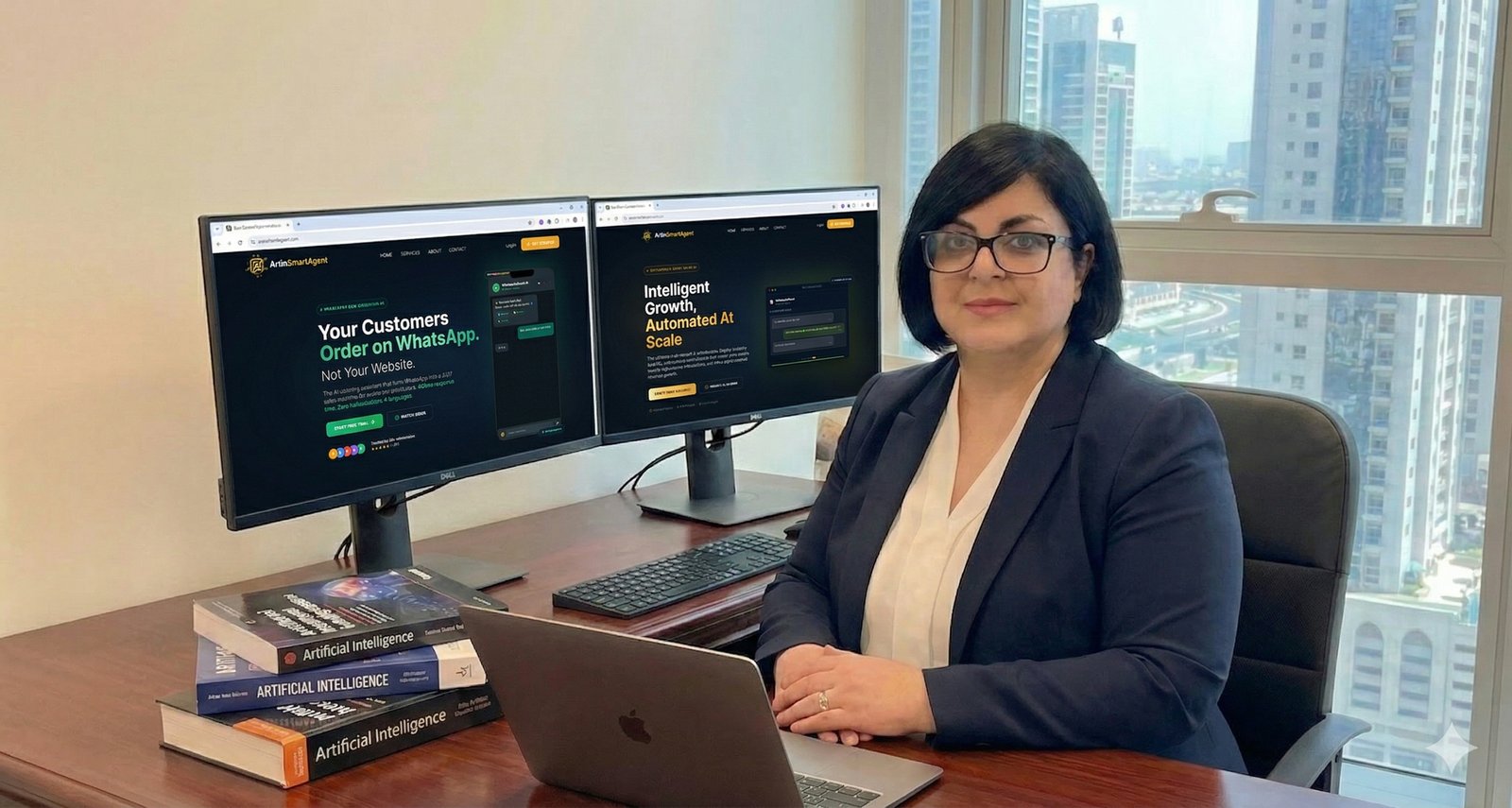
When businesses first consider adding AI to their customer communication, they face a fundamental choice: build a custom AI agent tailored to their specific business, or deploy a generic chatbot from a platform like Intercom, Tidio, or Drift. This choice fundamentally determines what your AI can actually do and what results you should expect. Understanding the difference between custom AI agents and generic chatbots is essential before making any technology investment.
What Is a Generic Chatbot?
Generic chatbots are pre-built software products designed to handle common customer service scenarios across a wide range of industries. They typically work with decision trees — predefined menus and scripted responses — or limited intent recognition that maps a small set of phrases to preset answer templates. Examples include Intercom, Tidio, Freshchat, and Zendesk Chat.
What Is a Custom AI Agent?
A custom AI agent is built specifically for your business using foundation AI models like Google Gemini, OpenAI GPT-4, or Anthropic Claude, and trained with your specific business context: your product catalog, your pricing, your processes, your customer personas, and your communication style. Unlike generic chatbots, a custom AI agent uses true natural language understanding — it can hold multi-turn conversations, connect to your live databases to retrieve real-time information, and complete transactions, not just answer questions.
The Five Critical Differences
1. Language Understanding
Generic chatbots work on intent classification: they try to match a customer’s input to one of a limited set of predefined intents. But if the customer asks “What is the damage for a checkup?” instead of “How much does a consultation cost?”, the bot often fails with “I did not understand that.”
Custom AI agents using LLMs understand natural language in its full complexity. Slang, idioms, mixed languages, incomplete sentences, typos — the AI handles all of these because it genuinely understands meaning. In the UAE, where customers routinely mix English with Arabic, Hindi, or Urdu in the same sentence, this difference is enormous.
2. Business Context
Generic chatbots have no knowledge of your specific business. Custom AI agents are trained on your specific context. For a wholesale food distributor, this means the AI knows every one of 217 products in the catalog, their alternative names in five languages, current pricing, seasonal availability, and typical order volumes for different customer types. This depth cannot be achieved with a generic tool.
3. Transaction Capability
Generic chatbots can guide users through workflows but cannot complete transactions. Custom AI agents are integrated into your backend systems — your ordering system, CRM, inventory database, calendar, and payment processor. They complete actions. An order is placed. An invoice is generated. An appointment is booked. This is what separates an AI agent from a chatbot: agency.
4. Scalability of Intelligence
Generic chatbots plateau quickly. Once you have answered the 50 most common questions, you have maxed out the value. Custom AI agents improve over time. When you add a new product, update pricing, or change your process, the AI is updated centrally and immediately applies the new knowledge across all conversations.
5. Multilingual Quality
Most generic chatbots offer multilingual support that is actually auto-translation — translating your English content into other languages. Custom AI agents built on models like Gemini 2.5 Pro generate responses natively in each language — constructed in the target language with proper idiom, register, and cultural appropriateness. An Arabic-speaking customer gets a response that reads as if written by a native Arabic speaker.
When to Use a Generic Chatbot
- Your customer interactions are truly simple and predictable (fewer than 50 unique question types)
- You need very rapid deployment (days, not weeks)
- Budget is extremely constrained
- You serve a single-language market
- Transactions happen entirely outside the chat channel
When to Use a Custom AI Agent
- Customer interactions involve complex, varied natural language
- Your business serves a multilingual customer base
- You want AI to complete transactions, not just answer questions
- Customer data needs to be integrated into the conversation
- You need the AI to operate across WhatsApp, web, and email consistently
- Your business needs to scale significantly without adding proportional staff
The Hidden Cost of Going Generic
Many businesses choose generic chatbots initially because the entry price is lower. The hidden cost is opportunity cost. Generic chatbots frustrate customers who expect intelligent responses. Abandonment rates on chatbot conversations that fail to understand are high. Customers who bounce from a chatbot to a competitor represent lost revenue that is rarely tracked but is very real.
A custom AI agent has a higher initial investment but a dramatically higher return: more conversations completed without human intervention, higher customer satisfaction, more transactions processed, more leads converted. The total cost of ownership over 12 months is almost always lower for a custom solution that works versus a generic one that frustrates.
Conclusion
The choice between custom AI agents and generic chatbots is fundamentally a choice between a tool built for your business versus one that accommodates your business as an afterthought. For businesses in the UAE’s complex, multilingual, high-velocity market, the difference directly determines your revenue, customer satisfaction, and competitive position.